
Imagine your child spitting out medicine every time you try to give it to them. You’ve tried mixing it with juice, hiding it in applesauce, even pretending it’s a magic potion-but nothing works. The clock’s ticking, the prescription’s half-empty, and you’re exhausted. This isn’t just a parenting struggle. It’s a public health issue. Up to 76% of children don’t take their prescribed liquid medications as directed, and the #1 reason? Taste.
Why Taste Matters More Than You Think
Pediatric medications aren’t designed for kids. They’re designed for efficiency, shelf life, and cost. That means bitter, chemical, or metallic flavors dominate. For adults, that’s annoying. For a 3-year-old, it’s a trauma. Studies show more than half of all pediatric adherence problems stem directly from bad taste. Kids don’t understand why they need medicine. All they know is: it hurts their mouth, it lingers, and it makes them gag. That’s where flavoring services come in. These aren’t gimmicks. They’re clinically proven tools used by pharmacies across the U.S. and beyond. When a child’s antibiotic tastes like grape or bubblegum instead of medicine, compliance jumps from 53% to over 90%. That’s not a small win. That’s life-changing.How Flavoring Services Actually Work
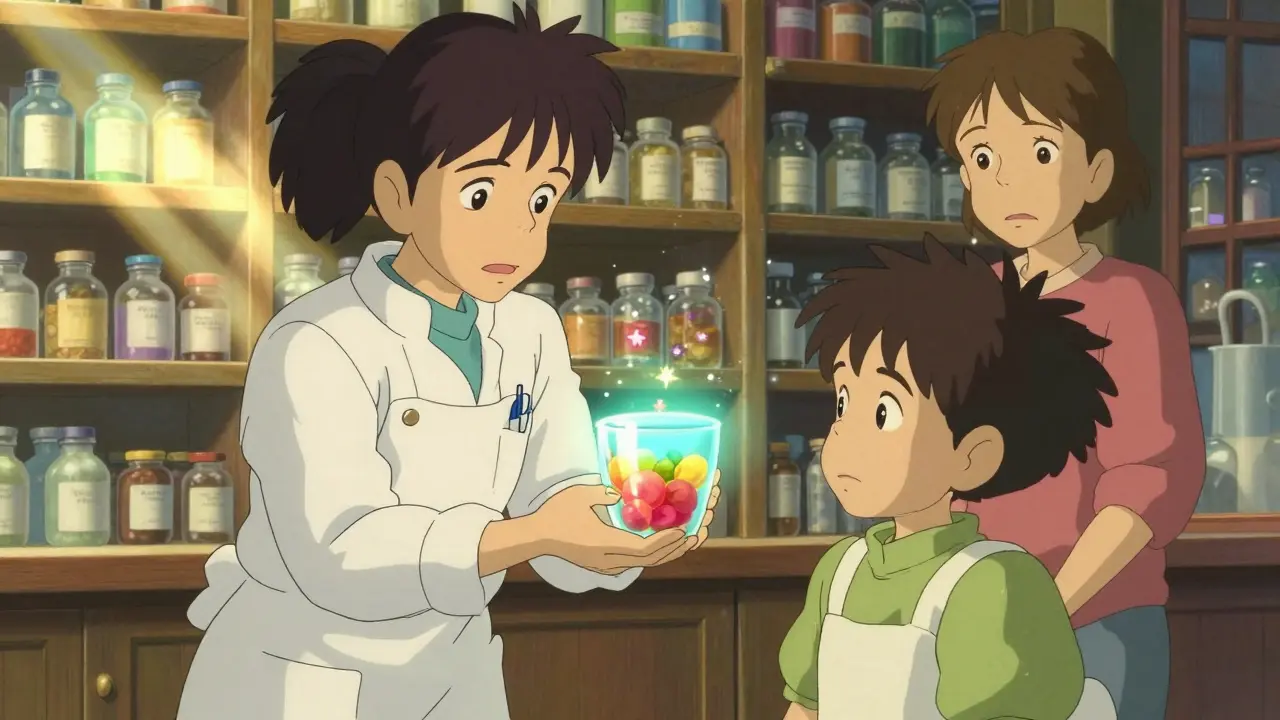
It’s simpler than you’d think. A pharmacist takes your child’s liquid prescription-whether it’s amoxicillin, azithromycin, or cefdinir-and adds a safe, food-grade flavoring agent. No special machines. No complex steps. Just a few drops, a quick stir, and the medicine is transformed. The flavoring agents used are dye-free, sugar-free, and allergy-safe. They don’t change the dosage, potency, or effectiveness of the drug. They only change the taste. Systems like FLAVORx have been around since the early 2000s and are now standard in many community pharmacies, including major networks like Intermountain Healthcare. The most commonly re-flavored medications are:- Augmentin
- Amoxicillin
- Azithromycin
- Cefdinir
- Clindamycin
- Grape
- Bubblegum
- Strawberry
- Watermelon
- Cherry
Why Home Tricks Don’t Work
You’ve probably tried mixing medicine with juice, yogurt, or chocolate syrup. It seems smart. But it’s risky. Mixing meds with food can alter how the body absorbs the drug. Some antibiotics lose effectiveness when paired with dairy. Others become too thick, making accurate dosing impossible. And if your child doesn’t finish the whole bowl? You’ve no idea how much they actually got. Flavoring services eliminate that guesswork. The medicine is dosed correctly, then flavored. No dilution. No absorption issues. Just pure, accurate, palatable medicine.
What Pharmacies Offer (and What They Don’t)
Most community pharmacies that offer flavoring services give you 5-10 flavor choices. Some even let the child pick. That small act-letting them choose grape over cherry-gives them a sense of control. It turns a forced ritual into a collaborative moment. The cost? Around $1.50 per prescription. That’s less than a candy bar. And for many families, it’s the difference between finishing the course and stopping early. But not all medications can be flavored. Some are too chemically sensitive. Some change viscosity or separate when flavoring is added. That’s why pharmacists evaluate each prescription before applying flavor. It’s not a one-size-fits-all service. It’s a professional judgment.Real Impact: From Battles to Routine
At Germantown Pharmacy in Mississippi, staff say kids who used to scream and cry now sit quietly while their medicine is prepared. One parent said their child started asking for their medicine because it tasted like bubblegum. Another said they no longer dread antibiotic season. This isn’t anecdotal. FLAVORx research shows non-compliance dropped from 76% to 20% when flavoring was used. The National Community Pharmacists Association found compliance jumped from 53% to over 90%. The FDA recognizes taste as a key factor in successful therapy. And doctors? They’re noticing the difference. Dr. Laura Tully, a pediatrician, calls flavoring a “quick and simple service” that fixes a problem many prescribers overlook. Dr. Michael Bartlett, who started researching pediatric taste issues in 2011 after seeing kids reject cancer meds, says the problem is systemic-and flavoring is one of the few practical fixes we have right now.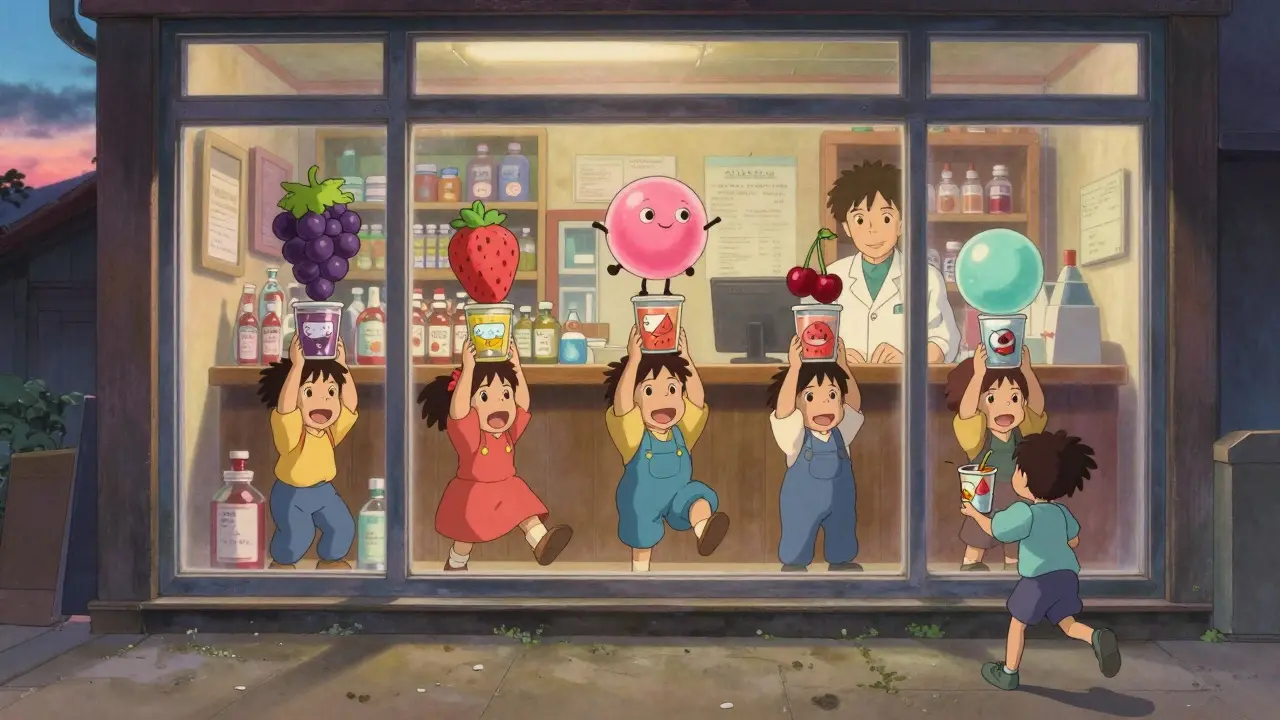
Limitations and What Comes Next
Flavoring isn’t magic. It won’t fix every adherence issue. Some kids develop flavor preferences so strong they refuse new medications that don’t match. Others still reject even the best-flavored liquids because of texture or smell. For those cases, chewable tablets or orally disintegrating tablets might be better options. And awareness? Still low. Many parents don’t know this service exists until they’re already in the middle of a medication battle. Pharmacists say they’re often asked, “Why didn’t you tell me about this sooner?” The future? More integration. More data. More research. The Frontiers in Drug Delivery review in 2025 called for routine inclusion of flavoring in pediatric care protocols. With healthcare systems moving toward outcomes-based payment models, adherence isn’t just a nice-to-have-it’s a financial imperative.What You Can Do Today
If your child is on a liquid medication and struggling to take it:- Ask your pharmacist if they offer flavoring services.
- Bring the prescription in early-don’t wait until the last dose.
- Let your child pick a flavor. It’s not just about taste-it’s about ownership.
- Don’t mix medicine with food unless the pharmacist says it’s safe.
- Keep the bottle labeled with the flavor chosen. It helps if you need a refill.
FAQ
Can any liquid medication be flavored?
Most liquid medications can be flavored, but not all. Some drugs react chemically with flavoring agents, changing their stability or effectiveness. Pharmacists check each prescription before adding flavor. Common ones like amoxicillin and azithromycin work well. Suspensions and syrups are usually fine. Tablets, capsules, or injectables can’t be flavored this way.
Is flavored medicine safe for kids with allergies?
Yes. Reputable flavoring services like FLAVORx use dye-free, sugar-free, nut-free, and gluten-free agents. They’re designed to be safe for children with common food allergies. Always confirm with your pharmacist that the specific flavoring used is allergy-safe for your child.
How much does it cost to flavor a child’s medicine?
The cost is typically around $1.50 per prescription. Some pharmacies include it for free as part of patient care. Others charge a small fee to cover the flavoring agent and labor. It’s one of the lowest-cost interventions with the highest impact on adherence.
Can I ask for flavoring on over-the-counter medicines?
Yes. Many pharmacies will flavor OTC liquid medicines like children’s ibuprofen or antihistamines. It’s not always advertised, so ask. Even if the medicine already has a flavor, you can often request a different one-like switching from cherry to grape if your child dislikes the original.
Will flavoring make my child addicted to sweet tastes?
No. The flavoring agents used are not sweeteners-they’re flavor compounds designed to mask bitterness without adding sugar or calories. They don’t train taste buds to crave sweets. Many children who use flavored medicine go on to eat healthy foods without issue. The goal isn’t to make medicine taste like candy. It’s to make it taste like something they won’t spit out.
Why don’t all pharmacies offer this service?
Some smaller pharmacies lack the training or supplier access. Others assume parents won’t use it. But demand is growing. Pharmacies that offer flavoring report higher customer loyalty, more referrals, and fewer medication-related follow-up calls. It’s becoming a standard service in family-focused pharmacies.
So let me get this straight-we’re paying $1.50 to make medicine taste like candy so kids don’t throw a fit? Next they’ll be flavoring insulin with cotton candy and calling it ‘self-care.’ 🙄
The real issue isn’t taste-it’s the systemic neglect of pediatric pharmacology. We design drugs for adults, then expect children to swallow chemical bitterness like it’s a rite of passage. Flavoring is a band-aid on a broken system. We need pediatric-specific formulations, not just sugar-coated placebos.
I had no idea this was a thing until my daughter started begging for her amoxicillin. Grape flavor. She calls it her ‘magic grape juice.’ We’ve had zero battles since. It’s not about making it sweet-it’s about making it bearable. And honestly? That’s enough.
I work in a pharmacy. We offer this service and maybe 1 in 10 parents ask for it. Most just assume it’s not possible. We should be advertising this better. It’s cheap. It’s safe. It works.
Americans spend $1.50 to fix a problem they created by not teaching kids to be tough. In Nigeria we just hold the nose and pour. No flavoring. No drama. Just medicine.
You’re telling me we’ve built an entire industry around masking bitterness instead of fixing the root cause? The pharmaceutical industry doesn’t care about kids. They care about profit margins. Flavoring is just another way to sell more pills while pretending they care.
This changed my life 😭 My 4yo used to cry for 20 minutes every dose. Now she says ‘Grape time!’ and holds out her cup. I cried the first time she asked for it. No joke. 🥹
Okay but let’s be real-this is just the tip of the iceberg. We’re letting corporations get away with making kids’ meds taste like battery acid because it’s cheaper than doing it right. And now we’re patting ourselves on the back for slapping on grape flavor like it’s a moral victory? Please. It’s a PR stunt wrapped in a $1.50 bottle cap. Meanwhile, kids in developing countries are still getting crushed by unpalatable, unaffordable, unflavored poison. This isn’t progress. It’s performative compassion.
I’m impressed by the innovation, but why does this service even exist? In the UK, we have pediatric-specific formulations designed from the ground up-not retrofitted with flavor drops. This feels like an American workaround for a problem we solved decades ago.
The pharmacoeconomic implications are profound. Flavoring agents represent a low-cost, high-impact adherence intervention that directly reduces downstream healthcare utilization-hospitalizations, ER visits, antibiotic resistance-all attributable to suboptimal dosing. This isn’t a gimmick. It’s a micro-intervention with macro-outcomes. The ROI is off the charts.
My kid won’t take anything even if it tastes like cotton candy. Texture is the real enemy. You need to talk about that too.
You’re right. Texture matters more than taste for some kids. That’s why some pharmacies now offer suspensions with different viscosities or switch to orally disintegrating tablets when flavoring isn’t enough. It’s not one-size-fits-all. But flavoring is the easiest first step.