
Every year in the U.S., over 1,000 applications for generic drugs are submitted to the FDA. These aren’t just paperwork - they’re the gateway for millions of people to afford life-saving medications. But who pays for the FDA to review them? The answer isn’t taxpayers alone. It’s the drug companies themselves - through something called generic drug user fees.
These fees come from a program called GDUFA - the Generic Drug User Fee Amendments. It started in 2012 and has been renewed twice since, most recently in 2022 to run through 2027. GDUFA isn’t a tax. It’s a system where generic drug makers pay the FDA to review their applications. In return, the FDA commits to faster, more predictable reviews. Without this funding, the process would crawl. With it, the system runs.
How GDUFA Works: The Pay-for-Performance Model
The FDA doesn’t get a blank check from Congress to handle generic drug reviews. In fact, about 75% of the budget for the Office of Generic Drugs comes directly from industry fees. That’s huge. It means the agency can hire more reviewers, upgrade its computer systems, and do more inspections - all because manufacturers pay to have their drugs reviewed.
This isn’t a free-for-all. GDUFA sets clear rules. Companies pay fees for four things:
- Application fees - $124,680 per Abbreviated New Drug Application (ANDA) submitted in FY 2023. This is what you pay when you ask the FDA to approve your generic version of a brand-name drug.
- Program fees - $385,400 per year for any company that has even one approved generic drug on the market. It’s an annual cost of doing business.
- Facility fees - $25,850 per year for each manufacturing site that makes active ingredients or finished pills for approved generics. If you own two factories, you pay twice.
- DMF fees - $25,850 when a drug master file (a technical dossier on how an ingredient is made) is first referenced in an application.
Here’s the key: paying these fees doesn’t guarantee approval. It just gets your application into the review line. The FDA still tests for safety, effectiveness, and quality. The fees just ensure there’s enough staff to do the job.
Why This System Exists: Before GDUFA
Before 2012, the generic drug review process was a mess. Applications piled up. Some took over three years just to get reviewed. Companies didn’t know where they stood. The FDA didn’t have enough money or staff to keep up.
Imagine waiting 36 months just to hear back if your drug could be sold. By then, the patent on the brand-name drug might have expired - and your chance to enter the market was gone. That’s what happened before GDUFA.
Today, the goal is to review 60% of original ANDAs within 15 months. In 2021, the FDA hit 52%. That’s still behind target, but it’s a massive improvement from 30+ months. Communication has gotten better too. Before GDUFA, deficiency letters were vague. Now, 90% of them give clear, actionable feedback. That’s huge for companies trying to fix issues quickly.
Costs Compared: Generic vs. Brand-Name Drugs
There’s a big difference between what generic drug makers pay and what brand-name drug makers pay. For brand-name drugs under PDUFA (the Prescription Drug User Fee Act), the application fee in 2023 was over $3.4 million. For generics? $124,680. That’s less than 4%.
Why the gap? Because brand-name drugs require full clinical trials - testing on humans, safety data, long-term studies. Generic drugs don’t. They just need to prove they’re the same as the brand-name version. So the review is shorter, cheaper, and faster. But there are far more generic applications. In 2022, the FDA received 1,128 ANDAs. Only 68 new brand-name applications came in. The system has to handle volume.
And it does. Since GDUFA started, generic drug approvals have jumped 22% per year. Over 97% of the FDA’s review goals were met in 2021. That’s not luck. It’s funding.
Who Pays the Most - and Who Struggles
The big players - Teva, Sandoz, Mylan - have dozens of approved drugs and multiple factories. For them, GDUFA fees are just part of the cost of doing business. But for small manufacturers? It’s different.
One small company might own just one facility and have three approved generics. Their annual GDUFA fees could be over $100,000. That’s 15% of their entire regulatory budget. Some have said they can’t expand production because they can’t afford the next facility fee.
The FDA knows this. That’s why small businesses can qualify for a 75% fee reduction. But only 18 such requests were approved in 2022. Why? Many don’t know they’re eligible. Others find the paperwork too complex. It’s a gap in the system.
And then there’s the facility fee. If your company owns one factory, you pay $25,850. If you’re part of a larger corporation with 10 factories? You pay $258,500. But the cost per factory is the same. That’s fair - unless you’re a mom-and-pop operation trying to compete with a multinational.
What’s Still Broken
GDUFA has fixed a lot. But not everything.
First, there’s the backlog. Even after 12 years, around 1,500 ANDA applications from before 2012 are still pending. The FDA says it will clear them all by September 2024. That’s good. But it shows how deep the problem ran.
Second, over-the-counter (OTC) drugs aren’t covered. Think cough syrup, antacids, pain relievers. These are huge - a $117 billion market. But they’re regulated under a different, outdated system. No user fees. No real timeline. Experts say expanding GDUFA to cover OTCs could generate $150-200 million a year and bring order to chaos.
Third, market concentration. Even with more generics entering the market, 20% of generic drug categories have only one or two suppliers. That means less competition - and higher prices. GDUFA helps get drugs approved faster, but it doesn’t fix monopolies. That’s a job for the FTC.
Real Impact: Money Saved, Lives Improved
Here’s the bottom line: generic drugs make up 90% of all prescriptions filled in the U.S. But they cost only 23% of what brand-name drugs do. That’s over $125 billion in annual savings.
Thanks to GDUFA, more generics hit the market faster after patents expire. The FTC estimates GDUFA helped increase timely generic entries by 15%. Over the past decade, that’s saved Americans $1.7 trillion.
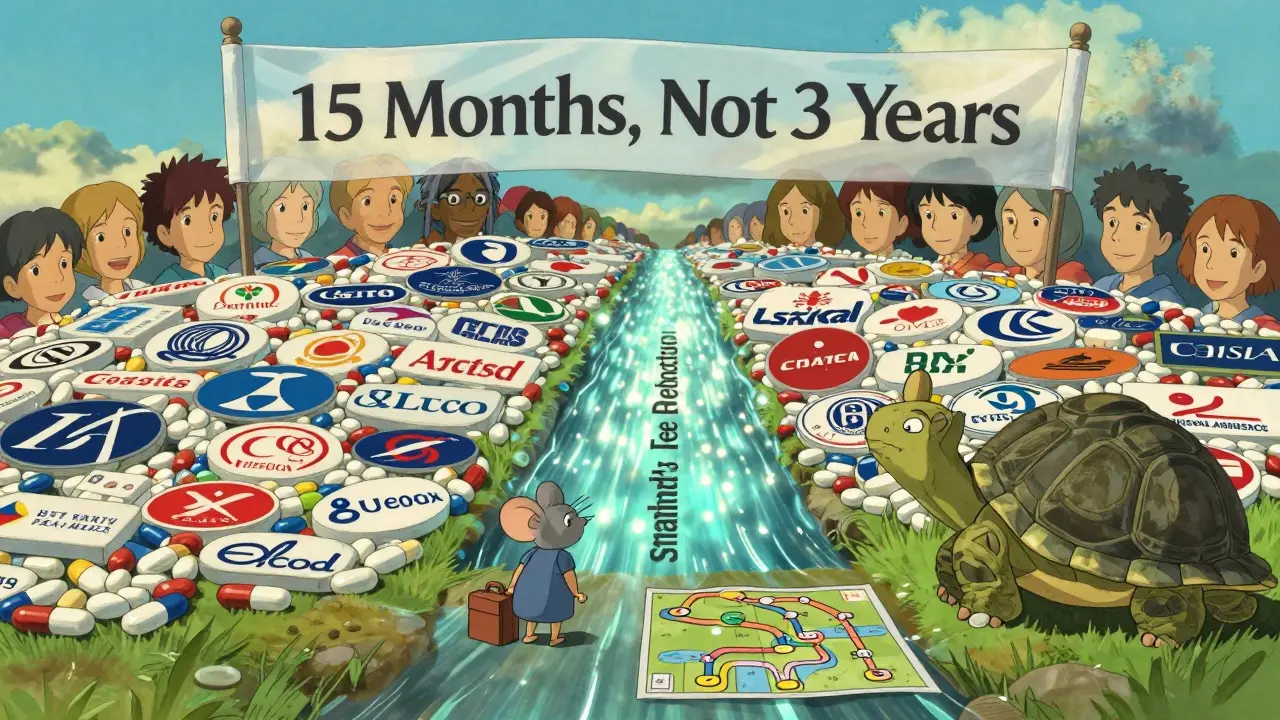
Imagine a diabetic who can’t afford insulin. Or a heart patient skipping doses because the brand-name pill costs $500. Generic drugs change that. And GDUFA makes sure those generics get approved - not in 3 years, but in 15 months.
What’s Next for GDUFA
The next reauthorization (GDUFA IV) is already being discussed. Ideas include:
- Using real-world data (like patient outcomes from pharmacies) to speed up post-market reviews.
- Expanding coverage to OTC drugs.
- Improving how fees are calculated for corporate affiliates.
The FDA’s 2023-2027 plan aims to cut the ANDA backlog by half by 2025. That’s ambitious. But with $1.20 in user fees for every $1.00 the FDA spends on generic reviews, the program is one of the most cost-effective tools in public health.
It’s not perfect. But it works. And for millions of people who rely on affordable medicines, that’s what matters most.
Do generic drug companies pay more fees than brand-name drug companies?
No, they pay far less. In 2023, the application fee for a brand-name drug under PDUFA was $3.4 million. For a generic drug under GDUFA, it was $124,680 - less than 4% of the brand-name fee. This reflects the lower complexity of generic drug reviews, which don’t require new clinical trials. However, generic manufacturers submit far more applications each year - over 1,000 - compared to about 70 for brand-name drugs.
Are GDUFA fees the same for every company, regardless of size?
The fee structure is the same, but small businesses can qualify for a 75% reduction. To qualify, a company must have fewer than 500 employees and no more than three approved generic drugs. Despite this, only 18 small business fee reductions were processed in 2022, suggesting many eligible companies don’t apply - likely due to confusion over the rules or lack of awareness.
Why don’t over-the-counter (OTC) drugs fall under GDUFA?
OTC drugs are regulated under a separate, decades-old system called the OTC Monograph Process. This system doesn’t use user fees and lacks clear timelines. As a result, many OTC products remain stuck in review limbo. Experts and lawmakers are now pushing to bring OTCs under GDUFA, which could generate $150-200 million annually and improve access to safe, affordable non-prescription medicines.
How does GDUFA affect drug prices in the U.S.?
GDUFA doesn’t set prices, but it helps lower them. By speeding up generic drug approvals, GDUFA increases competition. More generics in the market mean fewer monopolies. The FTC estimates GDUFA has helped increase timely generic entries by 15%, saving Americans $1.7 trillion over the past decade. Without GDUFA, many generics would still be stuck in review, delaying price drops.
What happens if a company doesn’t pay its GDUFA fees?
If a company doesn’t pay its GDUFA fees, the FDA won’t review its applications. For example, if a facility fee isn’t paid, any ANDA referencing that facility will be put on hold. The same goes for application or DMF fees - no payment, no review. The FDA tracks payments through its electronic system, and unpaid fees can delay market entry for months or even years.
So let me get this straight - drug companies pay the FDA to review their generics, and somehow this isn’t a conflict of interest? 🤔 I mean, if the FDA’s budget is 75% funded by the very people it’s supposed to regulate, who’s really watching the watchdog? The system works? Sure. But it’s like paying your landlord to fix the leaky roof while he’s also the one who owns the plumbing company. I’m not saying it’s broken - just that it’s a little too cozy for my comfort.
This system is dumb. Companies pay money. FDA do work. Simple. No need overthink.
The GDUFA model is a textbook example of regulatory efficiency through industry alignment. By shifting the cost burden to those who directly benefit - i.e., the manufacturers - you create a self-sustaining feedback loop where incentives are aligned: faster reviews → faster market entry → higher ROI for firms → sustained funding for the FDA. It’s not perfect, sure, but it’s a far cry from the bureaucratic quagmire of pre-2012. The real innovation here isn’t the fee structure - it’s the performance metrics. They actually measure output now. That’s revolutionary in federal agencies.
I appreciate how clearly this was laid out. Honestly, most people don’t realize that generics are the backbone of affordable healthcare in this country. I’ve had patients who cry when they find out their insulin is now $20 instead of $500. It’s not just economics - it’s dignity. And yes, the fee system is flawed for small players, but the fact that the FDA even has a reduction program? That’s more than most agencies do. We just need better outreach. Maybe a hotline? Or a one-pager in plain English?
There is, perhaps, a certain poetic irony in the fact that the mechanism which enables millions to access life-saving medication is funded by the very corporations whose profit margins it constrains. A capitalist solution to a public health problem - elegant, if not ethically unambiguous. The question is not whether GDUFA works - it clearly does - but whether we ought to be content with a system that relies on corporate self-interest to deliver what should be a fundamental right. I am not arguing for abolition. Merely for reflection.
I mean... I get it. The fees are fair. The system works. But let’s be real - if a small company has to pay $100k just to get reviewed, and the big boys pay $250k for ten factories... that’s not a level playing field. That’s a tax on ambition. And don’t even get me started on how nobody knows about the 75% discount. It’s like the government built a secret exit in a maze and then hid the map under a rock. #OverworkedAndUnderinformed
It is imperative to note that the structural integrity of this regulatory framework is predicated upon a transactional paradigm wherein private entities underwrite public functions. This is not a model of public service; it is a model of privatized oversight. The implications for democratic accountability are non-trivial. One must ask: if the FDA’s operational capacity is contingent upon industry payment, then whose interests are truly being served? The patient? Or the shareholder?
Honestly? This is one of the few government programs that actually works 😊. Like, no joke - I’ve seen the backlog numbers drop from 3 years to under 18 months. That’s huge. And yeah, small companies struggle, but they can get help. Maybe they just need a buddy system? Like, FDA could pair them with a mentor from a big pharma firm? 🤝 I’m all for more transparency, but let’s not throw out the baby with the bathwater. This thing saves billions every year. That’s real.
Bro. The FDA’s not some evil monster. They’re just trying to keep up with 1100 apps a year while juggling 68 brand-name behemoths. The fees? Yeah, they’re a pain. But imagine if you had to pay for 1000 reviews with taxpayer cash - you’d be screaming about taxes. Now you’re paying for your own review. It’s like ordering pizza and paying the delivery guy. You’re not getting robbed - you’re getting service. And if you’re a tiny startup? Use the discount. It’s right there. Stop whining and file the damn paperwork.
I just want to say - this entire system is a masterpiece of bureaucratic ingenuity. The fact that we’ve gone from a 3-year backlog to near-target timelines in under a decade? That’s not luck. That’s discipline. That’s vision. And yet, people still complain about fees. Do you know what happens when you remove user fees? You get chaos. You get stagnation. You get patients waiting. GDUFA isn’t perfect - but it’s the closest thing we’ve got to a functional, humane, and economically rational regulatory engine in this country. And if you’re against it? You’re not a reformer. You’re a sentimentalist with no grasp of reality.