
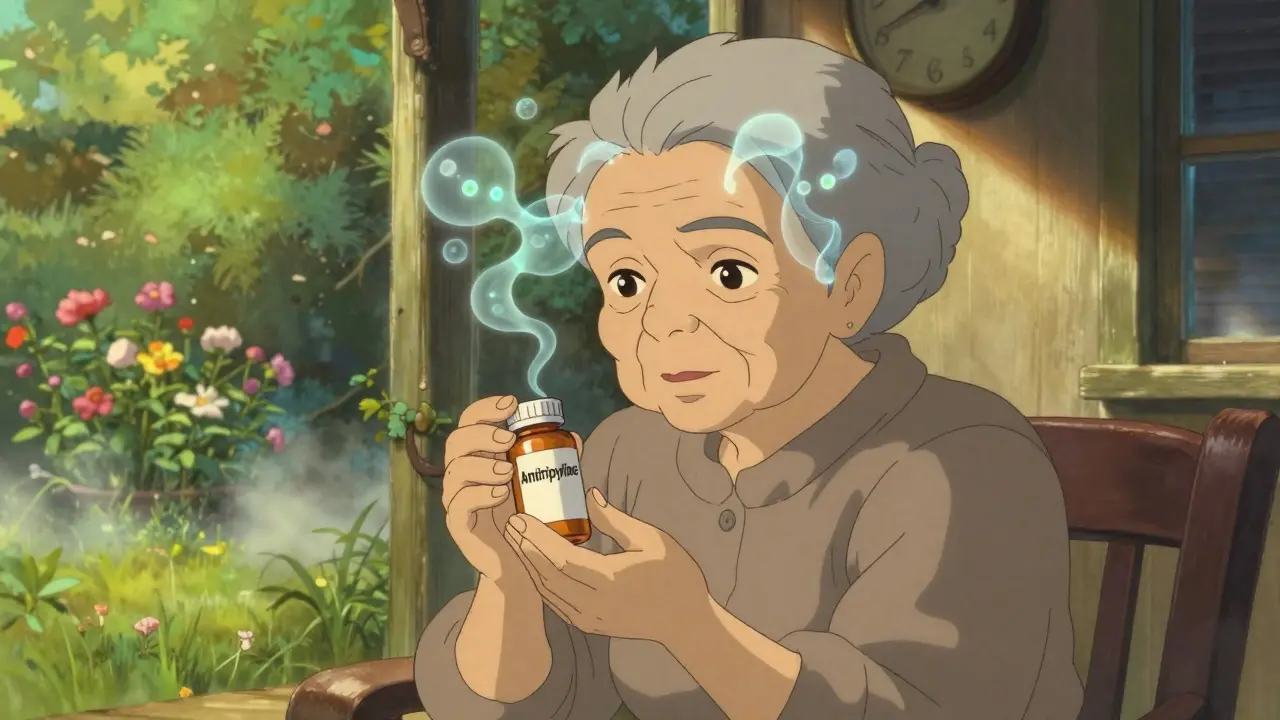
Anticholinergic Burden Calculator
How This Calculator Works
The Anticholinergic Cognitive Burden (ACB) Scale scores medications from 1 to 3 based on anticholinergic effects. A score of 3 means "definite high effect" and is the highest risk category. This calculator helps you determine your total burden score.
Your Medications
Your Anticholinergic Burden Score
Your total burden is below the threshold for concern. However, be aware of symptoms like dry mouth, constipation, or memory issues.
Common Medications with High ACB Scores
- Tricyclic antidepressants (e.g., Amitriptyline, Nortriptyline) - ACB 3
- First-generation antihistamines (e.g., Diphenhydramine, Chlorphenamine) - ACB 2-3
- Bladder control medications (e.g., Oxybutynin, Tolterodine) - ACB 1-3
- Motion sickness medications (e.g., Scopolamine) - ACB 2-3
- Some sleep aids (e.g., Doxylamine) - ACB 2-3
When you take a tricyclic antidepressant (TCA) like amitriptyline or nortriptyline, you’re not just treating depression or nerve pain-you’re also flooding your body with drugs that block a key brain chemical called acetylcholine. This isn’t a side effect you can ignore. It’s a silent, cumulative risk that can lead to memory loss, confusion, and even heart rhythm problems. And for people over 50, this isn’t just theoretical-it’s happening in real clinics, in real homes, and in real ER visits.
What Is Anticholinergic Burden?
Anticholinergic burden is the total amount of medication in your system that blocks acetylcholine. This chemical helps with memory, attention, digestion, bladder control, and even heart rhythm. When too many drugs block it, your body starts to malfunction in ways that look like aging-but they’re not.Doctors now use a tool called the Anticholinergic Cognitive Burden (ACB) Scale to measure this. It scores medications from 1 to 3:
- ACB 1 = possible anticholinergic effect
- ACB 2 = definite moderate effect
- ACB 3 = definite high effect
Tricyclic antidepressants? They all score 3. That’s the highest possible. Amitriptyline and nortriptyline are right up there with diphenhydramine (Benadryl) and oxybutynin (for overactive bladder)-medications known to cause brain fog and dry mouth. And when you add even one of these to other drugs like antihistamines or bladder pills, your total ACB score can quickly hit 3 or higher. That’s the red zone.
How TCAs Hurt Your Brain
The brain relies on acetylcholine to form memories and stay alert. Block too much of it, and your thinking slows down. At first, it might just feel like forgetting where you put your keys. Then, it becomes forgetting a friend’s name. Or missing appointments. Or getting lost in familiar places.A 2022 study tracked over 3,400 adults over 65 for seven years. Those taking medications with an ACB score of 3 or higher had a 54% higher risk of developing dementia. And here’s the scary part: the damage didn’t reverse right away. Even after stopping the drug, cognitive decline lingered for years. Some people never fully recovered.
It gets worse. In clinical practice, doctors often mistake these drug-induced symptoms for early dementia. A Reddit thread from psychiatrists in March 2023 described multiple cases where patients on amitriptyline were diagnosed with Alzheimer’s-only to show dramatic improvement after stopping the drug. Their memory came back. Their focus returned. Their diagnosis? Reversible anticholinergic delirium.
How TCAs Hurt Your Heart
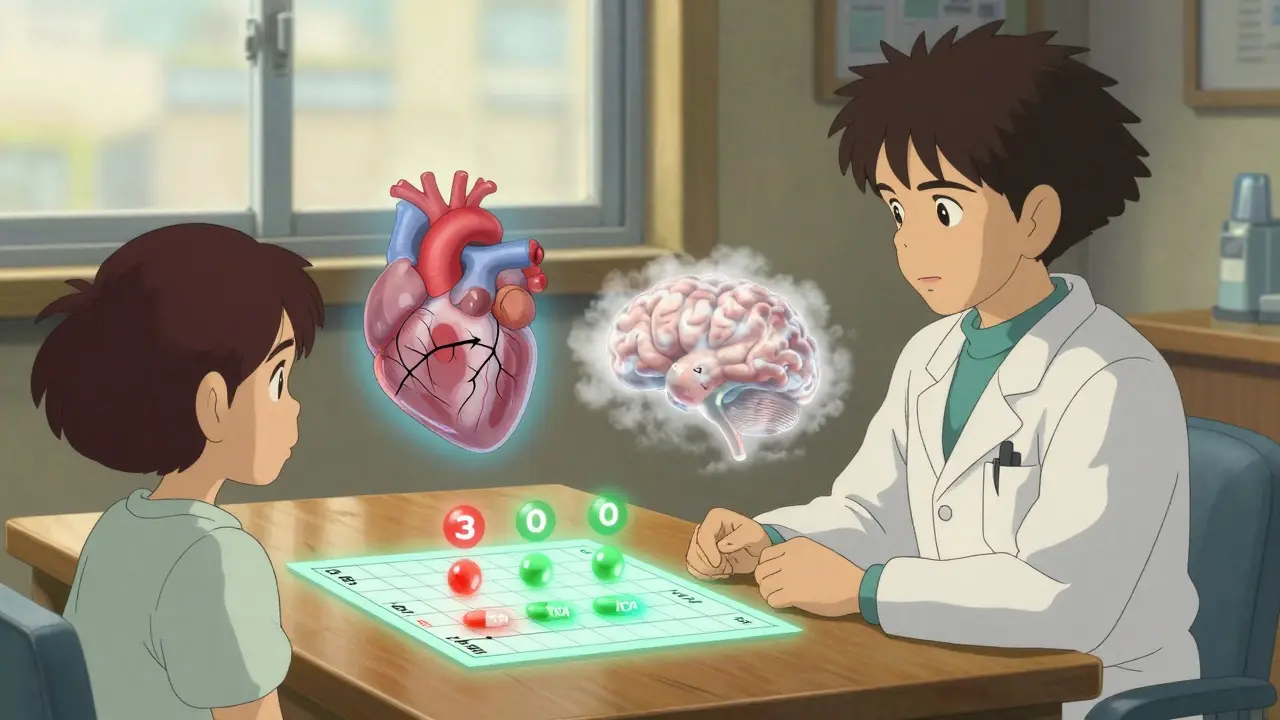
While your brain is struggling, your heart is under stress too. TCAs act like class 1A antiarrhythmics-they slow electrical signals in the heart, which sounds helpful until you realize it can cause dangerous rhythm disruptions.At therapeutic doses, amitriptyline can prolong the QRS complex on an ECG by 10-25%. In overdose? Up to 50%. That’s not a typo. That’s enough to trigger torsades de pointes-a life-threatening heart rhythm that can lead to sudden cardiac arrest.
Compared to SSRIs like sertraline, TCAs carry three times higher risk of arrhythmias. Amitriptyline specifically has been linked to a 2.8 times higher risk of QT prolongation than sertraline. For someone with existing heart disease, high blood pressure, or a history of fainting, this isn’t just risky-it’s dangerous.
One patient in the Mended Hearts online forum shared that after three weeks on amitriptyline for depression, she ended up in the ER with palpitations and a dangerously prolonged QT interval. She had no prior heart issues. The drug did it.
Why TCAs Are Still Prescribed
You might wonder: if they’re this risky, why do doctors still write these prescriptions?Because for some people, they still work. TCAs are powerful for treatment-resistant depression-when SSRIs and SNRIs have failed. They’re also one of the few drugs proven effective for neuropathic pain, fibromyalgia, and chronic headaches. In younger patients with no heart issues and no other meds, they can be a lifeline.
But for most people over 65? No. The risks far outweigh the benefits. The Beers Criteria, updated in 2023, says TCAs should be avoided in adults over 65 unless every other option has been tried and failed. And even then, the dose should be kept low.
Here’s the reality: in 2000, TCAs made up 15% of all antidepressant prescriptions in the U.S. By 2020, that dropped to 4.7%. Why? Because we now have safer alternatives. SNRIs like duloxetine and venlafaxine have ACB scores of 0 or 1. They don’t cause brain fog or heart rhythm problems. And they work just as well for depression and pain in most cases.
What You Should Do
If you’re on a TCA and you’re over 50, here’s what to do:- Check your total ACB score. Add up every medication you take-even OTC ones. Diphenhydramine (Nytol, Tylenol PM), chlorphenamine (Piriton), oxybutynin, and even some stomach meds like hyoscine can push your score over 3.
- Look for signs. Dry mouth? Constipation? Blurry vision? Trouble remembering? Feeling foggy? These aren’t just “getting older.” They’re signs your brain is being chemically slowed down.
- Ask your doctor about deprescribing. Don’t stop cold turkey. TCAs can cause withdrawal-nausea, anxiety, dizziness. But with a slow taper over 4-8 weeks, many people feel better. One NHS Somerset study found that 63% of older adults improved cognitively within six months of stopping high-ACB drugs.
- Ask about alternatives. Is duloxetine an option? What about CBT for pain or depression? Non-drug treatments are often just as effective-and zero risk.
And if you’re a caregiver? Pay attention. If your parent or grandparent suddenly seems confused, forgetful, or unsteady, ask: “Could this be from a medication?” Because sometimes, what looks like dementia is just a drug reaction-and it can be fixed.

The Bigger Picture
This isn’t just about TCAs. It’s about how we prescribe. We’ve gotten good at treating depression. But we’ve been bad at asking: “What else is this drug doing to the body?”Now, systems are changing. In the UK, 63% of electronic health records now auto-calculate ACB scores when a prescription is written. In the U.S., pilot programs are using AI to flag high-risk combinations before they’re filled. That’s progress.
But change happens one patient at a time. One doctor asking one question. One person saying: “I think this drug is making me worse.”
If you’re on a TCA and you’re over 50, you have every right to ask: Is this still necessary? Is there a safer way? And if the answer is yes-then you’re not giving up on treatment. You’re choosing better treatment.
Can tricyclic antidepressants cause dementia?
Yes. Long-term use of TCAs, especially in people over 65, is linked to a 54% higher risk of developing dementia over seven years. This isn’t just correlation-studies show cognitive decline can persist even after stopping the drug. The anticholinergic effect blocks acetylcholine, a key chemical for memory and attention, and this damage may be irreversible.
Are TCAs safer than SSRIs?
No. SSRIs like sertraline or escitalopram have an ACB score of 0 or 1, meaning they have little to no anticholinergic activity. TCAs like amitriptyline score 3, the highest possible. TCAs also carry three times the risk of heart rhythm problems compared to SSRIs. For most patients, especially over 50, SSRIs are safer and just as effective.
Can stopping a TCA improve memory?
Yes. Studies show that after carefully tapering off high-ACB medications like TCAs, up to 63% of older adults show measurable cognitive improvement within six months. Memory, attention, and processing speed often improve. This is why doctors now recommend reviewing all medications during cognitive decline assessments.
What medications increase anticholinergic burden?
Common ones include: TCAs (amitriptyline, nortriptyline), first-generation antihistamines (diphenhydramine, chlorphenamine), bladder meds (oxybutynin, tolterodine), motion sickness pills (scopolamine), and some sleep aids (doxylamine). Even one of these combined with a TCA can push total ACB score into the high-risk range.
Should I stop taking my TCA if I’m over 65?
Don’t stop abruptly. Talk to your doctor. The Beers Criteria recommends avoiding TCAs in adults over 65 unless other treatments have failed. If you’re on one, ask if a safer alternative exists-like an SNRI or non-drug therapy. With a slow taper over 4-8 weeks, many people feel better and avoid serious risks.
Next Steps
If you’re currently taking a TCA:- Make a full list of every medication you take, including supplements and OTC drugs.
- Use the ACB Calculator (available through bpacnz or NHS resources) to score your total burden.
- Ask your doctor: “Is this drug still necessary? Are there safer options?”
- If you’re over 50 and experiencing memory issues, constipation, or dry mouth, ask if your meds could be the cause.
The goal isn’t to scare you. It’s to empower you. You don’t have to live with brain fog or heart risks just because a drug was prescribed years ago. Better options exist. And you have the right to ask for them.
Let me tell you something - TCAs are the pharmaceutical equivalent of driving a 1987 Buick with bald tires and a broken brake line. You think it’s fine ‘cause it still moves, but one bump and you’re in the ditch. I’ve seen grandmas on amitriptyline forget their own grandkids’ names. And then they get labeled ‘dementia’? Nah. That’s not aging. That’s pharmacology gone rogue. We’re not treating depression here - we’re chemically sedating the elderly into silence. And the worst part? No one asks if they actually want to feel ‘calm’ when they’re just fogged out.
My aunt was on nortriptyline for 7 years. Started forgetting her wedding day. Then she stopped. Six months later? She was baking pies again, remembering birthdays, laughing at dumb memes. No therapy. No ‘cognitive rehab.’ Just… stopping the poison. Why isn’t this common knowledge? Because pharma doesn’t profit from ‘just quit the drug.’
Thank you for sharing this. It’s so important to raise awareness about how medications can silently harm us over time. Many older adults are not given the full picture before starting these drugs. I hope more doctors take the time to review medication lists with their patients - especially when cognitive changes appear. Small changes in prescribing can lead to big improvements in quality of life.
I work in geriatric care and this is exactly why I started advocating for ACB scoring in our clinic. We had a patient who was misdiagnosed with early-onset Alzheimer’s. Turned out she was on amitriptyline + diphenhydramine + oxybutynin. Total ACB score: 7. After tapering, her MMSE score improved by 12 points in 4 months. It’s not magic. It’s pharmacology. We need to stop seeing ‘memory loss in seniors’ as inevitable. It’s often iatrogenic.
Also - if you’re a caregiver, keep a meds list. Write it down. Bring it to every appointment. Don’t assume the doctor remembers everything. They don’t.
Bro this is wild 😳 I was on amitriptyline for migraines and I thought I was just getting old… then I stopped and suddenly I remembered where I put my keys for the first time in 2 years 🤯
Also my heart was doing backflips 😭 went to ER thinking I was having a heart attack - turned out QT was 580. Doc said ‘you’re lucky you didn’t drop dead.’
PS: My grandma’s still on it. I’m sending her this. She’s gonna be mad. Worth it.
The anticholinergic burden paradigm represents a critical inflection point in pharmacovigilance. TCAs, by virtue of their high ACB score, constitute a class of drugs that exert pleiotropic effects on the central and autonomic nervous systems. The clinical implications are not merely theoretical - they are evidenced by longitudinal cohort data demonstrating significant cognitive decline trajectories. It is imperative that prescribers integrate ACB scoring into routine medication reconciliation protocols. Furthermore, the integration of AI-driven CDS tools into EHR systems is not optional - it is a clinical necessity.
Alternative therapeutic modalities such as SNRIs and CBT demonstrate non-inferior efficacy with superior safety profiles. Transition protocols must be standardized and institutionalized.
ok so i just read this and i’m crying?? like i didn’t even know my mom’s forgetfulness was from meds?? she’s been on nortriptyline and benadryl for 10 years??
and now i feel so guilty for not noticing??
also i think i’m on something too?? i get so foggy after taking that allergy pill??
can someone tell me if this is real?? or am i just overthinking??
also i love you for writing this
Wait - so you’re saying SSRIs are better? Lol. Have you seen the weight gain? The sexual dysfunction? The emotional blunting? TCAs at least let you feel something. Even if it’s dry mouth and a racing heart. At least you’re still alive in your body. SSRIs? You’re just… numb. Like a robot on vacation.
Also - dementia? My uncle had dementia and he was on Zoloft. So it’s not just TCAs. You’re cherry-picking.
And why are we assuming all elderly people want to be ‘sharp’? Maybe they just want peace. Maybe the fog is a gift.
This is so important. I’m a nurse and I’ve seen this over and over. One of my patients stopped her TCA and started walking again - she hadn’t walked to the mailbox in 3 years. Her eyes cleared up. She started reading books. She cried and said, ‘I didn’t know I was gone.’
And yes - OTC meds matter. Tylenol PM? That’s diphenhydramine. ACB 3. One pill. One drug. One disaster waiting to happen.
Please share this with your older relatives. Even if they think you’re being dramatic. They’ll thank you later.
❤️
Interesting. In the UK, we’ve been moving toward deprescribing for years. The BNF now flags high ACB drugs clearly. But awareness among GPs is still patchy. I’ve seen patients on 5+ anticholinergics. No one questioned it. It’s systemic. Not individual.
Also - the heart risks are underreported. QT prolongation doesn’t always show on ECGs unless you’re looking for it. Routine ECGs for elderly on TCAs? Should be standard.
One thing people miss: this isn’t just about depression. It’s about how we treat pain. TCAs were the go-to for neuropathic pain because they worked. But now we have gabapentinoids, SNRIs, even topical lidocaine. Why are we still defaulting to the oldest, riskiest tool? Because it’s cheap. Because it’s familiar. Because no one wants to relearn.
And here’s the uncomfortable truth - the people who benefit most from TCAs are often the ones least able to advocate for themselves. Elderly. Low-income. Isolated. We need systems, not just awareness.
There’s a quiet tragedy here - we’ve turned the human body into a machine we can tweak with pills, and then act shocked when it breaks down.
Acetylcholine isn’t just a neurotransmitter. It’s the ghost in the machine - the spark of presence, the thread that holds memory, identity, awareness together.
When we block it, we don’t just cause side effects. We erase parts of a person. Slowly. Quietly. Until they’re not themselves anymore… and everyone says, ‘Oh, they’re just getting old.’
Maybe the real question isn’t ‘Should we stop TCAs?’
It’s: ‘Why did we ever think this was okay?’
I find it fascinating how this narrative is being weaponized as a moral panic. The pharmaceutical-industrial complex is not monolithic. The reductionist framing of TCAs as 'poison' ignores the nuanced reality of clinical decision-making. Furthermore, the notion that cognitive decline is 'reversible' is statistically overstated. The 2022 study you cite has significant confounding variables - polypharmacy, socioeconomic status, baseline cognition. And let us not forget: the placebo effect in deprescribing trials is substantial. You are promoting a narrative of fear, not evidence. This is not medicine. This is digital activism masquerading as clinical guidance.