
When you pick up a prescription, you might not notice the difference between the brand-name pill and the generic one sitting in your bag. But behind that swap is a detailed, science-backed system the FDA uses to decide if it’s safe to substitute one for the other. That system? Therapeutic equivalence codes. These two-letter codes-like AB, BC, or BX-are not just bureaucratic labels. They tell pharmacists exactly which generics can be swapped without risking your health or treatment outcome.
What Therapeutic Equivalence Really Means
Therapeutic equivalence isn’t about pills looking the same or costing less. It’s about whether two drugs-brand and generic-deliver the same clinical effect and safety profile when used the same way. The FDA doesn’t just assume they work the same. They require proof.To earn an ‘A’ rating, a generic must meet three strict criteria:
- It must contain the same active ingredient, strength, dosage form, and route of administration as the brand-name drug (that’s pharmaceutical equivalence).
- It must show bioequivalence-meaning it gets into your bloodstream at the same rate and amount as the brand.
- It must have the same labeling and be manufactured under the same quality standards.
Only then does the FDA assign it a therapeutic equivalence code. Over 90% of approved generic drugs in the U.S. carry an ‘A’ rating. That’s why pharmacists can swap them automatically in 49 states without asking your doctor.
Decoding the Letters: A vs. B Ratings
The first letter tells you everything. ‘A’ means substitutable. ‘B’ means not recommended for substitution-unless your doctor says otherwise.But ‘A’ isn’t just ‘A’. There are subcategories:
- AB: The most common. The generic has passed bioequivalence testing against the original brand. AB1, AB2, AB3, AB4? Those mean there are multiple brand-name versions (called Reference Listed Drugs), and the generic matches one of them specifically.
- BC: Extended-release tablets or capsules with potential bioequivalence issues. These are tricky because how the drug releases over time matters.
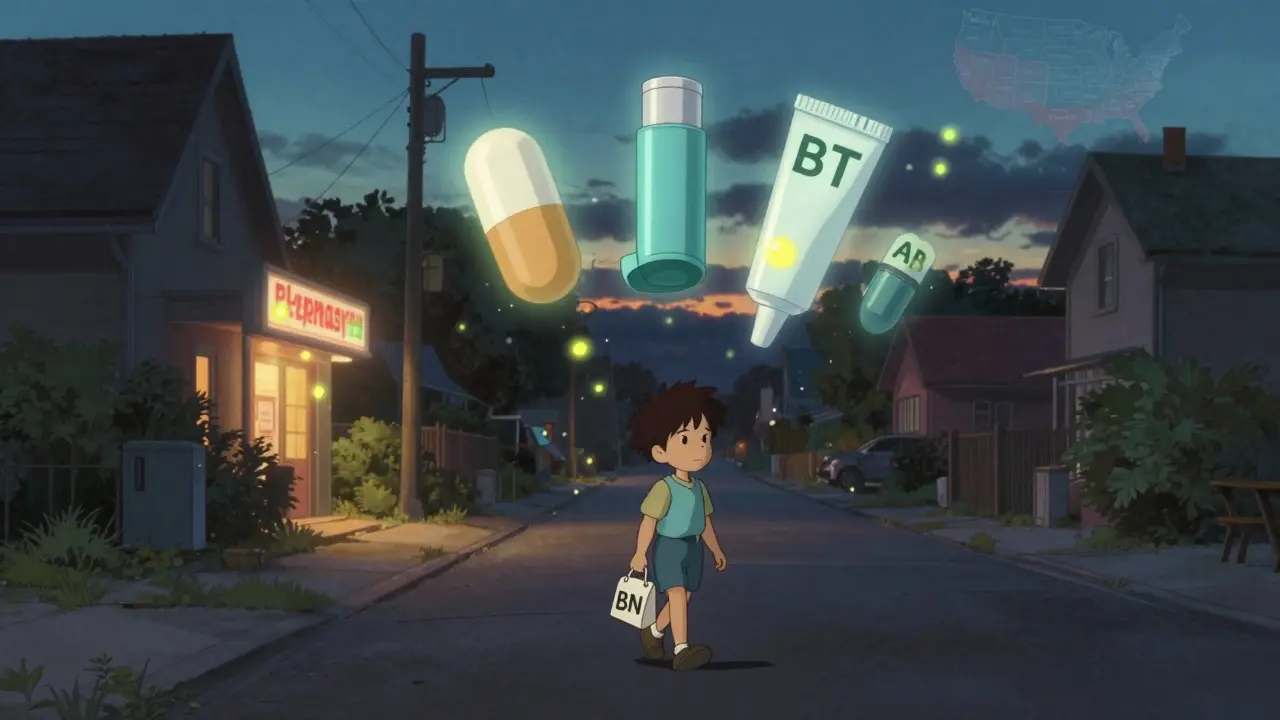
- BT: Topical products like creams or gels. Skin absorption is hard to measure, so these often get a ‘B’ even if they seem identical.
- BN: Aerosol inhalers. The delivery device affects how much drug reaches your lungs, making bioequivalence harder to prove.
- BX: Not enough data. The FDA hasn’t seen enough studies to say whether it’s safe to substitute.
Don’t assume a ‘B’ code means the generic is bad. It just means the science isn’t clear enough yet to guarantee substitution won’t change your outcome. For example, a topical steroid with a ‘BT’ code might work just as well as the brand-but the FDA can’t be certain because skin absorption varies too much between people.

Why the System Exists-and Why It Matters
The U.S. generic drug market saves patients and insurers about $370 billion a year. Without therapeutic equivalence codes, pharmacies couldn’t swap generics automatically. Doctors would have to write ‘Dispense as Written’ on every script. Pharmacists would need to call every prescriber for approval.The Orange Book-the FDA’s official list of approved drugs with therapeutic equivalence ratings-makes this possible. It’s updated monthly. Pharmacists check it weekly. In fact, a 2022 survey found that 87% of community pharmacists rely on it to make substitution decisions.
But here’s the catch: not all doctors know how to read these codes. A 2022 AMA survey showed that 42% of physicians were confused by ‘B’ ratings. Some refused substitution even when the generic was appropriate. Others didn’t realize a ‘B’ didn’t mean the drug was unsafe-just that substitution wasn’t automatically approved.
Where the System Falls Short
The FDA’s system works great for simple pills-like metformin or lisinopril. But it struggles with complex products.Take inhalers. Two inhalers might have the same drug and dose, but if the spray mechanism or particle size differs slightly, the amount reaching your lungs can vary. That’s why many inhaled generics get ‘BN’ codes-even if they’re clinically effective.
Same with topical creams. A generic cortisone cream might have the same active ingredient, but if the base (the cream’s texture) changes, absorption changes. The FDA’s current bioequivalence tests don’t fully capture that.
Dr. Duxin Sun from the University of Michigan pointed out in a 2022 study that the current system was designed for simple oral drugs. It wasn’t built for injectables, transdermal patches, or complex nasal sprays. That’s why the FDA is working on new guidelines to improve how it evaluates these products.
What You Should Know as a Patient
You don’t need to memorize codes. But here’s what to do:- If your pharmacist gives you a generic, check the label. If it’s an ‘A’ code, you’re good to go. No action needed.
- If you get a generic with a ‘B’ code, ask your pharmacist: ‘Is this safe to substitute?’ They can tell you why it got that rating.
- If your doctor writes ‘Dispense as Written’ or ‘Do Not Substitute,’ they’re overriding the system. That’s their right-and sometimes necessary.
- Never assume a ‘B’ code means the drug doesn’t work. It just means substitution isn’t automatic. You might still take it-just not swapped without approval.
For most people, generic drugs are safe, effective, and cost-saving. The FDA’s therapeutic equivalence system exists to protect that. It’s not perfect, but it’s the most reliable tool we have to ensure that a $4 generic pill does the same job as a $40 brand-name one.
What’s Changing in 2025?
The FDA is updating its approach. In 2022, they released draft guidance to improve how they evaluate complex generics. By 2027, they aim to cut ‘B’ ratings for complex products by 30%. That means more inhalers, creams, and injectables could get ‘A’ codes in the future.They’re also using more real-world data-like patient outcomes from electronic health records-not just lab tests. This could help close the gap for products where traditional bioequivalence studies fall short.
For now, the system still works. Over 12,600 of the 14,000 drugs listed in the 2023 Orange Book have an ‘A’ rating. That’s why 90% of prescriptions in the U.S. are filled with generics-and why you’re saving hundreds, sometimes thousands, a year without even knowing it.
What does an AB code mean on a generic drug?
An AB code means the generic drug has been proven to be therapeutically equivalent to the brand-name drug. It contains the same active ingredient, strength, dosage form, and route of administration, and has passed FDA bioequivalence testing. This means it can be safely substituted without any change in effectiveness or safety.
Can a pharmacist substitute a drug with a B code?
No, a pharmacist cannot automatically substitute a drug with a B code. These products are not considered therapeutically equivalent to the brand-name version based on current data. Substitution requires a doctor’s explicit approval. Some B-rated drugs may still be effective, but the FDA hasn’t confirmed that substitution won’t affect outcomes.
Are all generic drugs rated in the Orange Book?
No. Only multisource prescription drugs-that is, drugs with both brand and generic versions-are assigned therapeutic equivalence codes. Over-the-counter (OTC) medications, single-source drugs (only the brand exists), and biological products like insulin or vaccines are not rated in the Orange Book.
Why do some generic inhalers have a BN code?
Inhalers get a BN code because the delivery device-how the drug is sprayed, particle size, and how it’s inhaled-affects how much reaches the lungs. Even if the drug is identical, differences in the inhaler design can change effectiveness. Current testing methods can’t fully prove bioequivalence for these products, so they’re flagged as BN until better methods are developed.
How often is the Orange Book updated?
The Orange Book is updated monthly. New generic approvals, code changes, or withdrawals are added each month. Pharmacists and prescribers rely on these updates to make accurate substitution decisions. You can check the latest version on the FDA’s official website.
Ugh, I swear half the time my pharmacist swaps my meds and I feel like a different person. Last month I got some generic lisinopril with an AB code and I was dizzy for three days. They say it's 'the same'-but my body knows better. Don't trust the system. I'm switching back to brand and paying the extra $50. My health isn't a cost-cutting experiment.
Let me tell you something the FDA doesn't want you to know-this whole 'therapeutic equivalence' thing is a corporate shell game. Big Pharma owns the reference drugs, controls the bioequivalence studies, and the FDA just rubber-stamps it. They don't test real-world outcomes, just lab numbers. And now they're pushing 'A' ratings for inhalers? Please. If it was safe, why did 12% of asthma patients have flare-ups after switching? Someone's getting rich while we get sick.
i just found out my generic omeprazole is bc rated and i had no clue. i thought all generics were equal. now i'm kinda scared to take it. maybe i should call my doc?
It is with profound respect for the scientific rigor of the U.S. Food and Drug Administration that I acknowledge the extraordinary diligence with which therapeutic equivalence codes are assigned. The meticulous bioequivalence trials, the controlled pharmaceutical standards, and the transparent Orange Book database represent not merely bureaucratic procedure-but a sacred covenant between the state and the citizen to preserve health with unwavering integrity. This system, though imperfect, is the bedrock of American pharmaceutical excellence.
I’ve been a pharmacist for 15 years and I can tell you-95% of the time, generics are totally fine. But the B-rated ones? Yeah, they’re the ones that make you pause. I had a patient on a BT-rated cream for eczema who got the generic and broke out worse. We switched back and she was fine. It’s not about the drug-it’s about the delivery. The system’s good, but it’s not magic.
so if a drug is bx, does that mean it’s not even tested? or just not enough? i’m confused.
You know, in my village back home, we don’t have fancy codes or Orange Books. We just take what works. If the pill makes you feel better, it’s good. If it don’t, you find another. Maybe the real problem isn’t the generic-it’s that we’ve turned medicine into a spreadsheet. The body don’t care about AB1 or BX4. It just wants to heal.
my cousin in nigeria just got a generic version of his HIV med and he’s fine. but i heard here they give it a bx because 'absorption varies'? that seems kinda messed up. how come the same drug works overseas but not here? maybe our standards are too strict? or maybe they’re just not trying hard enough?
As a healthcare professional with over two decades of clinical experience, I must emphasize the critical importance of therapeutic equivalence codes in preserving patient safety, ensuring regulatory compliance, and maintaining the integrity of our public health infrastructure. The FDA’s methodology, though complex, is grounded in reproducible science, peer-reviewed data, and longitudinal clinical outcomes. To dismiss these codes as bureaucratic red tape is to ignore the very foundation of evidence-based medicine.
Just read this whole thing. Kinda wild how much goes into something you just grab off the shelf. I never thought about how inhalers are so tricky. Makes me appreciate the pharmacists who actually read the labels instead of just handing you whatever’s cheapest.
meh. i don't care. my insurance picks the generic anyway.
They’re letting foreign labs run bioequivalence tests now. I read it in a newsletter. China, India, Vietnam-they’re all doing the 'studies' for our drugs. How do we know they’re not faking the data? The FDA doesn’t even send inspectors anymore. That’s why so many 'A' ratings are fake. We’re being poisoned with Chinese generics and nobody’s talking about it.
Just got my first generic with a BX code. Pharmacist said it’s 'not recommended' but 'might work'. I’m gonna try it. 🤞💊