
MAOI Food Safety Checker
Check if your food choices are safe while taking MAOI antidepressants. This tool helps you avoid potentially dangerous tyramine levels that can cause hypertensive crisis.
When you're taking an MAOI for depression, your food choices aren't just about taste or nutrition-they can be a matter of life or death. Monoamine oxidase inhibitors like phenelzine, tranylcypromine, and isocarboxazid work by stopping your body from breaking down certain brain chemicals, which helps lift mood. But they also stop your body from breaking down tyramine, a compound found in many foods. When tyramine builds up, it can spike your blood pressure to dangerous levels-sometimes over 200 mmHg-in minutes. This isn't a theoretical risk. In 1964, a patient died after eating cheddar cheese while on phenelzine. Today, that same cheese, if properly stored, might be safe. But the confusion hasn't gone away.
What Exactly Is Tyramine and Why Does It Matter?
Tyramine is a natural substance formed when proteins in food break down over time. It’s not poison. It’s in ripe bananas, aged cheese, and even soy sauce. Your body usually handles it fine with the help of an enzyme called monoamine oxidase-A (MAO-A). But when you take an irreversible MAOI, that enzyme gets shut down. Tyramine floods into your bloodstream, forcing your body to release huge amounts of norepinephrine. That’s what causes the spike in blood pressure, pounding headache, rapid heartbeat, and sometimes stroke or heart attack.The old rule was: avoid anything aged, fermented, or stored. But that’s outdated. Modern food production has changed everything. A 2021 study in Food Chemistry found that store-bought cheddar cheese, kept cold and sold within 6 months, has only 0.1-1.0 mg of tyramine per 100 grams. Back in the 1970s, it was 30-100 mg. That’s a 99% drop. The same goes for smoked fish, meats, and even some wines. The real danger isn’t the food itself-it’s how it’s handled.
Which Foods Are Still Dangerous?
Not everything is safe. Some foods still pack a dangerous punch, especially if they’re not stored right. Here’s what to avoid:- Aged cheeses (over 6 months old): Parmesan, blue cheese, brie, camembert, and cheddar that’s been sitting on the shelf too long. If it’s labeled “extra aged” or “artisanal,” skip it.
- Tap beer and unpasteurized beer: These are fermented in barrels and can contain 5-35 mg of tyramine per 100 ml. Bottled, pasteurized beer is usually fine in small amounts.
- Dry fermented sausages: Salami, pepperoni, and summer sausage can have 25-150 mg per 100g. Fresh sausage is okay.
- Improperly stored fish or meat: If it’s been sitting in the fridge for more than 48 hours, tyramine levels can jump 100-fold. Leftovers? Don’t risk it in the first 4 weeks.
- Soy sauce and miso: These are high-risk. Soy sauce can contain 10-118 mg per 100g. Tofu is safer if it’s fresh and under 100g per serving.
- Overripe bananas and avocados: The pulp of a ripe banana is fine-under 1.5 mg. But if it’s brown and mushy, it’s risky. Avocados under 100g are okay.
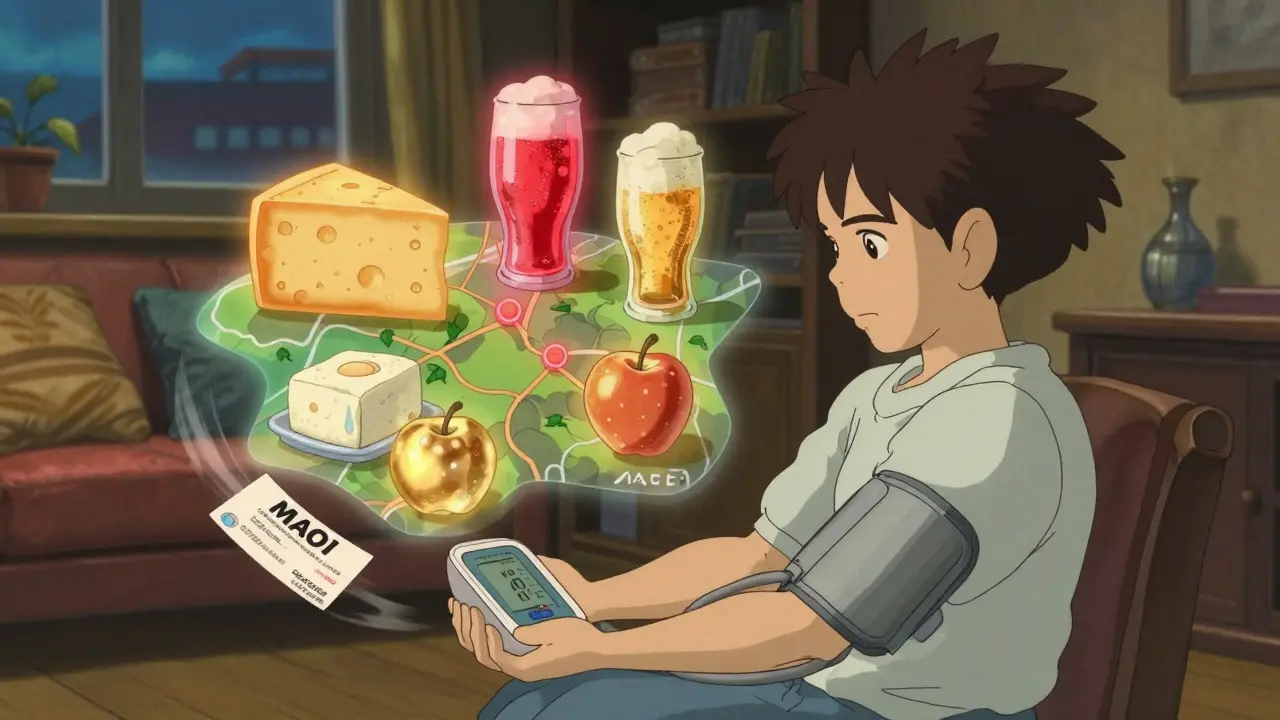
Here’s the catch: it’s not about eating one risky food. It’s about stacking them. Eating a slice of aged cheese, a glass of tap beer, and some soy sauce in one meal could push you over 25 mg of tyramine-the level where serious reactions start. That’s why the new guidelines focus on single-item exposure, not blanket bans.
The New Safety Plan: Less Fear, More Strategy
The old MAOI diet was a minefield. Today, experts like Dr. David M. Taylor from King’s College London say we need precision, not panic. Here’s how to build a real safety plan:- Start fresh. In the first 4 weeks on an MAOI, eat only freshly cooked meals. No leftovers. No deli meats. No cheese from the deli counter. Stick to plain chicken, rice, vegetables, and fresh fruit.
- Use a food diary. Write down everything you eat and when. Note your blood pressure before and 2 hours after meals. If your systolic pressure jumps more than 30 mmHg after a meal, that food is a trigger for you.
- Know your limits. One serving of aged cheese (150g) every 3 days is the max. One 330ml bottle of pasteurized beer per week. One tablespoon of soy sauce every few days. Don’t combine.
- Check storage. If food has been in the fridge longer than 48 hours, throw it out. If it smells off, smells like ammonia, or looks slimy, it’s not worth the risk.
- Use the USDA database. The USDA now tracks tyramine levels in over 500 foods. You can find online charts showing safe portions. For example: fresh mozzarella (0.5 mg/100g), plain yogurt (0.2 mg/100g), and apples (0.1 mg/100g) are all safe.
Transdermal selegiline (Emsam) at 6 mg/day is an exception. Because it’s absorbed through the skin, it doesn’t block MAO-A in the gut the same way. You can eat most foods without restriction at this dose. But if you’re on 9 mg or 12 mg, you’re back to full restrictions.
What to Do If Your Blood Pressure Spikes
A hypertensive crisis doesn’t always come with warning signs. You might feel fine, then suddenly your head explodes with pain, your vision blurs, and your heart races. That’s not anxiety-it’s a medical emergency.Here’s what to do immediately:
- Check your blood pressure. If it’s above 180 mmHg systolic, act fast.
- Take 0.2-0.4 mg of sublingual nifedipine (if prescribed by your doctor). This lowers blood pressure within minutes.
- Call 911 or go to the ER. Do not wait. Do not drive yourself.
Carry an MAOI identification card at all times. It should say: “I am taking an MAOI antidepressant. Do not administer sympathomimetics. Risk of hypertensive crisis.” Many pharmacies offer free cards. Keep one in your wallet and one in your phone’s notes.
What Happens When You Stop Taking MAOIs?
You can’t just quit. The enzyme takes 2-3 weeks to rebuild. That means dietary restrictions don’t end when your last pill is gone. You must still avoid high-tyramine foods for at least 14 days after stopping. Some doctors recommend 21 days, especially if you were on a high dose. Mixing an MAOI with another antidepressant, even after stopping, can cause serotonin syndrome. Wait at least 2 weeks before starting an SSRI or SNRI.
Are There Better Alternatives?
MAOIs aren’t the first choice anymore. SSRIs and SNRIs are easier and safer. But for people who’ve tried 3 or more antidepressants and still feel stuck, MAOIs work better. Studies show a 50-60% response rate in treatment-resistant depression, compared to 30-40% for SSRIs. That’s why they’re still used in specialized clinics, even though they make up only 1-2% of all antidepressant prescriptions in the U.S.There’s also moclobemide, a reversible MAOI available outside the U.S. It lets your body break down tyramine naturally after a few hours. You can eat cheese and wine without fear. It’s not FDA-approved, but many patients travel abroad for it.
Final Thoughts: It’s Not About Perfection
The goal isn’t to live on a diet of plain rice and boiled chicken forever. It’s to understand your risk and make smart choices. Most people on MAOIs never have a crisis-if they follow the basics: fresh food, no leftovers, no aged cheese, no tap beer, and check blood pressure regularly.If you’re on an MAOI, you’re not broken. You’re managing a powerful tool. With the right knowledge, you can eat well, live fully, and stay safe. The science has caught up. Now it’s time for the fear to let go.
Can I eat chocolate while on MAOIs?
Yes, in moderation. Up to 30 grams of dark or milk chocolate is generally safe. Chocolate contains very little tyramine-under 1 mg per 100g. But avoid large amounts or chocolate that’s been stored for months. Also, skip chocolate with added nuts or dried fruit if you’re unsure of their storage.
Is red wine safe with MAOIs?
Most red wines are safe in small amounts-up to 120 ml (4 oz) once a week. The tyramine level is low (under 5 mg per 100 ml). But avoid wine that’s been open for days or stored in warm places. Also, skip fortified wines like port or sherry-they’re higher in tyramine and riskier.
Can I take over-the-counter cold medicine with MAOIs?
No. Many decongestants like pseudoephedrine, phenylephrine, and dextromethorphan can cause dangerous spikes in blood pressure when mixed with MAOIs. Always check labels and ask your pharmacist. Use saline nasal sprays or antihistamines like loratadine instead.
What if I accidentally eat something risky?
Don’t panic. Monitor your blood pressure closely for the next 2-4 hours. If it stays under 160 mmHg systolic, you’re likely fine. If it climbs above 180, take your prescribed nifedipine and call emergency services. Keep your MAOI ID card handy.
Do I need to avoid all soy products?
No. Fresh tofu (under 100g per serving) is generally safe. Avoid soy sauce, miso, tempeh, and fermented soy products-they’re high in tyramine. Check labels: if it says “fermented” or “aged,” skip it. Stick to plain, refrigerated tofu and check the expiration date.
Why do some doctors say the diet is outdated?
Because modern food storage and production have drastically lowered tyramine levels. A 2023 USDA study found 68% of previously restricted foods now contain less than 2 mg per 100g. The old diet was based on food from the 1950s-poorly stored, fermented, and aged. Today’s refrigerated, pasteurized, and packaged foods are much safer. Experts now recommend individualized plans, not blanket bans.
Is it safe to drink coffee while on MAOIs?
Yes. Coffee does not contain tyramine. However, caffeine can slightly raise blood pressure, so if you’re already sensitive, limit it to 1-2 cups a day. Avoid energy drinks-they often contain stimulants that can interact dangerously with MAOIs.
Next Steps for Patients
If you’re starting an MAOI:- Ask your doctor for a copy of the USDA tyramine database or a printed food list.
- Buy a home blood pressure monitor and log readings daily.
- Get your MAOI ID card from your pharmacy.
- Inform all your healthcare providers-you’re on an MAOI.
- Wait 2 weeks after stopping before starting any other antidepressant.
If you’ve been on MAOIs for a while and feel restricted, talk to your prescriber. You might qualify for a more flexible plan based on your dose, medication type, and food history. You don’t have to live in fear-you just need to be informed.
Man, I was terrified of MAOIs until I read this. I thought I’d have to live on plain rice forever. Turns out I can have a slice of cheddar now and then? That’s life-changing. I’ve been on phenelzine for six months and haven’t had a single scare - just check the fridge date and skip the tap beer. Seriously, this post saved my social life.
Thanks for laying it out so clearly. No more panic-buying tofu and avoiding every cheese counter.
Also, chocolate? YES. 30g? I’m already planning my next treat.
Oh, so now we’re supposed to trust the USDA?? The same agency that approved aspartame and let Big Pharma push SSRIs for 20 years?? This is just corporate propaganda dressed up as science!!
Did you know that tyramine levels can spike if the refrigeration breaks for just 4 HOURS?? And who’s checking that?? Supermarkets? The same ones that let expired yogurt sit out for days??
And don’t get me started on ‘pasteurized beer’ - that’s just a marketing lie! Fermentation doesn’t stop just because it’s bottled!!
They’re lying to you. They always lie. Your blood pressure will spike. You’ll wake up in the ER with a hemorrhage. I’ve seen it. I’ve seen it.
Stick to boiled chicken. And pray.
And yes, I know this sounds paranoid. But you’re not paranoid if they’re REALLY out to get you.
I’m sorry, but this is dangerously irresponsible. You’re telling people it’s ‘fine’ to eat cheese if it’s ‘fresh’? Who defines ‘fresh’? The store? The consumer? You? You’re putting lives at risk.
My cousin died on an MAOI. He ate a ‘safe’ slice of brie. It was ‘only’ 3 days old. He had a stroke at 29. That’s not a ‘risk’ - that’s a death sentence waiting to happen.
And now you’re telling people to ‘log their blood pressure’ like it’s a Fitbit trend? This isn’t wellness blogging. This is pharmacology. You don’t gamble with brain chemistry.
Stop normalizing this. The old rules were there for a reason. And if you’re not following them, you’re not being careful - you’re being selfish.
Y’all are overcomplicating this. Here’s the real deal: if it looks weird, smells weird, or has been sitting in your fridge longer than your last relationship - toss it.
Don’t stress over exact mg counts. Just eat fresh. Cook at home. Avoid anything that says ‘aged,’ ‘fermented,’ or ‘artisanal’ unless you know the farmer personally.
And yes - chocolate is fine. Coffee is fine. Apples are fine. You’re not a lab rat. You’re a human who just needs to be smart.
My mom’s been on MAOIs for 12 years. She eats sushi, drinks red wine, and still hugs her grandkids. She didn’t die. She just followed the basics.
Stop fear-mongering. Start living.
Let’s be brutally honest - the entire ‘modern tyramine safety’ narrative is built on cherry-picked data from industrial food corporations. The USDA database doesn’t account for regional storage variations, shipping delays, or temperature fluctuations in rural areas.
Also, the 2021 Food Chemistry study? It tested 12 samples of cheddar. That’s not statistically significant. It’s a sample size used for a high school science fair.
And you think 0.1 mg per 100g is ‘safe’? What’s the LD50? What’s the cumulative effect over 6 months? No one’s studied that. No one’s even tried.
This isn’t progress. It’s pharmaceutical convenience masked as science. And you’re the naive ones falling for it.
Stay on the old diet. Or don’t. But don’t pretend you’re being ‘evidence-based’ when you’re just trusting the same system that gave you OxyContin.
This is the kind of post that makes me believe in Reddit again. Thank you. I’ve been on isocarboxazid for 8 months and was terrified to leave the house. Now I know I can have a glass of wine with dinner. Not every night. Not every bottle. But once a week? Yes.
I even tried a tiny bit of blue cheese last week. No headache. No panic. Just a quiet victory.
You’re right - it’s not about perfection. It’s about awareness. And this guide? It’s the roadmap I wish I’d had six months ago.
You’re not just helping people avoid a crisis. You’re helping them reclaim their lives.
The fact that people are debating whether cheddar is safe shows how far we’ve drifted from clinical caution. In the UK, we still teach the old guidelines. Not because we’re outdated - because we’ve seen the consequences.
There’s a reason the NHS doesn’t endorse ‘flexible tyramine limits.’ It’s because individual variability isn’t just theoretical - it’s lethal.
One person’s ‘safe’ cheese is another person’s emergency room.
Don’t confuse modern food safety with medical safety. They’re not the same thing.
And if you’re using the USDA database as gospel, you’re missing the point: medicine isn’t a spreadsheet.
Look - I’ve been on selegiline for two years. I eat sushi, I drink wine, I snack on salami sometimes. And I’ve never had a problem.
But here’s the thing: I don’t just ‘trust the science.’ I’ve spent two years testing my own body. I ate a whole block of blue cheese once. Watched my BP like a hawk. No spike. So I know my limits.
That’s what this post is really about - not blanket bans, but personal discovery.
It’s not about being reckless. It’s about being curious. And yeah, maybe that’s scary. But so is living in fear of cheese.
Also - chocolate? Yes. Dark chocolate with sea salt? Even better. I’m not dying for it. I’m living for it.
So let me get this straight - we’re supposed to trust a 2021 study over 60 years of medical warnings? And the FDA? Oh wait, they didn’t even approve most of these ‘safe’ foods for MAOI use. They just stopped banning them.
It’s like saying ‘e-cigarettes are safe’ because they don’t have tar. But we still don’t know the long-term effects.
Also, ‘check your blood pressure’? Great. So now you’re telling depressed people to become amateur nurses? That’s not empowerment. That’s burden.
And ‘don’t combine foods’? Right. Because when you’re in a grocery store, you’re gonna calculate tyramine loads like a chemist.
Yeah. Sure.
This isn’t safety. It’s wishful thinking with a spreadsheet.
While the information presented is largely accurate and grounded in recent literature, I would urge caution in the interpretation of tyramine thresholds. The assumption that 25 mg is a universal trigger point is not supported by robust clinical trials. Individual sensitivity varies widely due to genetic polymorphisms in MAO-A, hepatic metabolism, and concurrent medication use.
Furthermore, the recommendation to use sublingual nifedipine requires explicit physician authorization and is not universally appropriate. In some patients, particularly those with cardiovascular comorbidities, this intervention may pose additional risk.
While the intent of this post is commendable, the reduction of complex pharmacology into bullet points may inadvertently encourage non-adherence in vulnerable populations. A structured consultation with a clinical pharmacist remains the gold standard.
Wow. You Americans think you can just ‘check the fridge’ and be safe? 😂
In Nigeria, we know what happens when you trust ‘modern food’ - the same stuff that gives you diabetes, hypertension, and heart attacks. You think tyramine is the only danger? What about the preservatives? The plastic packaging leaching into your cheese? The fact that your ‘pasteurized’ beer is made in a factory with 12-year-old machines?
Stick to boiled chicken. Or don’t. But don’t pretend you’re smarter than your ancestors who survived without refrigerators.
And if you’re gonna drink wine? At least make sure it’s not from a plastic bottle. 🙄
Also - chocolate? Nah. Even the ‘safe’ kind has sugar that makes your brain worse. You’re on an MAOI for depression - not for a dessert buffet.
Stay safe. Stay traditional. 😇
Just eat fresh. No leftovers. No weird cheese. No tap beer. Done.
Don’t overthink it. Don’t stress about mg counts. If it looks like it’s been on the shelf since 2021 - throw it out.
And if you’re worried? Call your doctor. They’ve seen this a thousand times.
You got this.