
When a pharmacist hands you a generic pill instead of the brand-name version, you might wonder: Is this really the same thing? The answer isn’t just a guess - it’s written in the FDA’s Approved Drug Products with Therapeutic Equivalence Evaluations, better known as the FDA Orange Book. This isn’t some dusty manual. It’s a live, daily-updated database that tells pharmacists, doctors, and insurers exactly which generics can be swapped for brand-name drugs without risking your health. If you’re trying to save money on prescriptions, understanding how to use this tool correctly could mean the difference between safe substitution and a dangerous mix-up.
What the FDA Orange Book Actually Does
The Orange Book isn’t just a list of drugs. It’s the official source for therapeutic equivalence ratings - the FDA’s scientific judgment on whether a generic drug performs the same way in your body as the brand-name version. Since 1984, the Hatch-Waxman Act gave the FDA the power to approve generics faster by letting them rely on the brand’s safety data, as long as they prove they’re bioequivalent. That’s where the Orange Book comes in. It tracks over 16,000 approved drug products, including both prescription and some over-the-counter meds. But here’s the key: only prescription drugs get therapeutic equivalence codes. OTC drugs? They’re not rated. That’s because the FDA doesn’t require them to prove they work the same way as other OTC versions - just that they’re safe.
Every drug in the Orange Book has a reference listed drug (RLD). That’s the original brand-name version the generic is trying to copy. The generic isn’t marked as the RLD - it’s marked as a copy. And next to each copy, you’ll see a two-letter code. That’s the therapeutic equivalence (TE) rating. If it says AB, you’re good. That means the FDA has confirmed the generic is pharmaceutically identical and bioequivalent to the brand. No hidden differences. No surprises.
Decoding the TE Codes: AB, BX, and More
Not all codes are created equal. The FDA uses a simple but critical system:
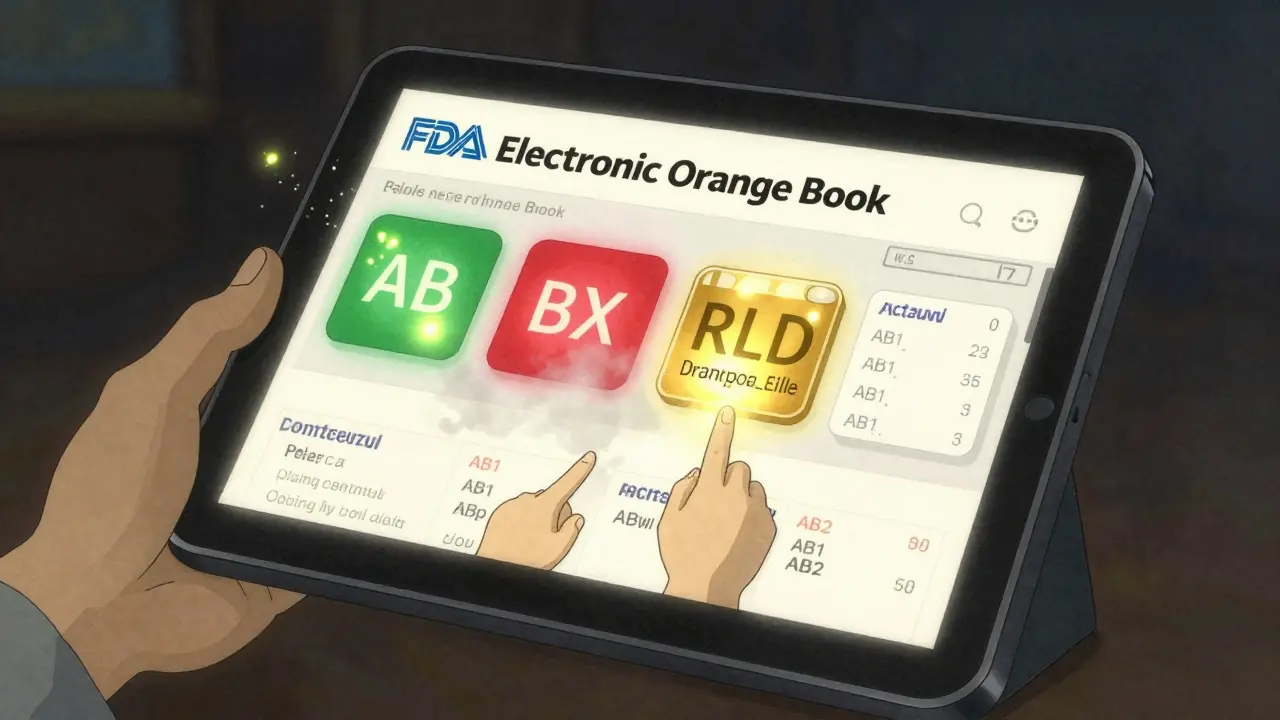
- AB = Therapeutically equivalent. This is what you want. The generic has been tested and approved to work just like the brand. You can safely substitute it.
- BX = Not rated. This is a red flag. The FDA hasn’t found enough evidence to say the generic is equivalent. Maybe the drug is hard to test (like inhalers or topical creams), or there’s inconsistent data. Don’t assume it’s safe to swap.
- AB1, AB2, AB3 = These mean the generic matches one of several possible reference drugs. For example, if two different brand versions of levothyroxine exist, the FDA assigns AB1 to generics matching the first, AB2 to those matching the second. Mixing them up can lead to dosing errors.
Here’s a real example: Synthroid (levothyroxine) has multiple AB-rated generics. But because levothyroxine has a narrow therapeutic index - meaning even tiny differences in dose can cause problems - many states require a doctor’s approval before switching. The Orange Book tells you the drug is AB-rated. It doesn’t tell you your state’s law says you still need permission. That’s on you to check.
How to Search the Electronic Orange Book (Step by Step)
You don’t need to be a pharmacist to use it. The Electronic Orange Book is free, public, and updated daily. Here’s how to find what you need in under five minutes:
- Go to the FDA’s Electronic Orange Book website - it’s hosted on the FDA’s official domain. Don’t use third-party sites like Drugs.com unless you’re double-checking. They can be 24 to 72 hours behind.
- Use the search bar and type in the brand name (e.g., “Lipitor”). Click “Search.”
- Look for the RLD in the results. The brand-name drug will have “Yes” under the RLD column. The generics will say “No.”
- Check the TE Code column. If it says “AB,” that generic is approved for substitution. If it says “BX,” skip it.
- Confirm the dosage form. A 10mg tablet might be AB-rated, but the 20mg capsule might be BX. They’re not interchangeable.
- Watch for numerical suffixes. If you see AB1 and AB2, make sure you’re matching the right reference drug. This matters most with complex drugs like thyroid meds or seizure drugs.
Pro tip: If you’re looking for a generic by active ingredient (like “amlodipine”), use the “Ingredient Search.” It pulls up every version of that drug - brand and generic - sorted by dosage form. That’s the fastest way to compare all options at once.
What the Orange Book Doesn’t Tell You
Even if a drug is AB-rated, it doesn’t mean you can always swap it. The Orange Book gives you the FDA’s green light - but state laws and insurance rules can block you.
For example, 48 states allow pharmacists to substitute AB-rated generics automatically - unless the doctor writes “Dispense as Written” or “Do Not Substitute.” But in some states, even that isn’t enough. For drugs with narrow therapeutic indices - like warfarin, lithium, or levothyroxine - pharmacists may be required to notify the prescriber before switching. The Orange Book doesn’t flag these cases. You have to know the drug class.
Also, the Orange Book doesn’t tell you about shortages. A generic might be AB-rated, but if the manufacturer has stopped production, you won’t get it. That’s why pharmacists cross-check with the FDA’s Discontinued Drug Product List - a separate database that’s easy to miss.
And patents? The Orange Book lists them, but that’s not the same as market exclusivity. A drug might have expired patents, but still be protected by 180-day exclusivity granted to the first generic applicant. That means even if a generic is AB-rated, it might not be on the market yet. Don’t assume availability just because it’s rated.
Common Mistakes Pharmacists and Patients Make
Even trained professionals get tripped up. Here are the top three errors:
- Mixing up AB1 and AB2. Two different brands of metformin might have different inactive ingredients. If the pharmacy switches you from one AB1 to an AB2 without checking, you could get a different absorption rate. That’s rare, but it happens.
- Assuming OTC drugs are rated. You can’t use the Orange Book to compare generic ibuprofen brands. The FDA doesn’t evaluate them. If you’re sensitive to fillers, stick to the same brand.
- Trusting third-party apps without verification. Some pharmacy software pulls data from the Orange Book but doesn’t update daily. I’ve seen cases where a drug was pulled from the market last week, but the app still showed it as available. Always check the FDA site directly before making a substitution decision.
One pharmacist in Texas told me she once substituted a generic for a patient on warfarin. The TE code was AB. But the patient’s INR spiked. Turns out, the generic had a different filler that affected absorption. The Orange Book said it was equivalent - but in that one patient, it wasn’t. That’s why doctors sometimes prefer to keep patients on the same generic brand. The FDA’s rating is a population-level standard. Individual reactions vary.

When to Trust the Orange Book - and When to Doubt It
The Orange Book is the gold standard. But it’s not magic. It’s a tool. Here’s how to use it wisely:
- Trust it for routine prescriptions: antibiotics, blood pressure meds, statins, antidepressants. These are well-studied, and AB-rated generics work fine.
- Double-check for narrow therapeutic index drugs: thyroid meds, epilepsy drugs, blood thinners, immunosuppressants. Even small differences matter. Talk to your doctor before switching.
- Verify if you’re switching between different generic brands. Just because both are AB doesn’t mean they’re identical. Some patients report side effects when switching between generics - even if they’re both rated AB.
- Ignore it for OTC drugs, compounded medications, or biologics. Those are in different systems.
The FDA says over 90% of prescriptions in the U.S. are filled with generics. That’s because the Orange Book works. It’s kept prices low and access high. But its power comes from being used correctly. Don’t treat it like a black box. Learn how to read it. Know what the codes mean. And when in doubt - ask your pharmacist. They’re trained to use this tool every day.
Where to Get Help
The FDA offers free training: a 12-page Quick Reference Guide, video tutorials on YouTube (search “FDA Drug Info Rounds Orange Book”), and email support at [email protected]. Responses usually come within two business days. If you’re a patient, ask your pharmacist to show you how to read the TE code on your prescription label. Most will be happy to explain.
For professionals: the Electronic Orange Book’s search function lets you filter by patent expiration, exclusivity status, and applicant. Use it. It’s there to help you avoid legal and clinical risks.
What does an AB rating mean in the FDA Orange Book?
An AB rating means the FDA has determined the generic drug is therapeutically equivalent to the brand-name reference drug. It has the same active ingredient, strength, dosage form, route of administration, and has passed bioequivalence testing. This means it can be safely substituted for the brand without affecting the patient’s treatment outcome.
Can I trust any generic labeled as AB-rated?
Generally, yes - but not always. AB-rated generics are considered interchangeable by the FDA. However, for drugs with a narrow therapeutic index - like warfarin, levothyroxine, or lithium - even small differences in absorption can matter. Some patients experience side effects when switching between different AB-rated generics. Always consult your doctor before switching, especially for critical medications.
Why are some generics not rated in the Orange Book?
Generics are marked as BX (not rated) when the FDA lacks sufficient data to confirm therapeutic equivalence. This often happens with complex drug forms like inhalers, topical creams, or injectables where bioequivalence is hard to measure. Some generics may also be too new or have incomplete testing. Never assume a BX-rated drug can be safely substituted.
Is the Orange Book the same as the Purple Book?
No. The Orange Book covers small-molecule chemical drugs - both brand and generic. The Purple Book lists biological products, including biosimilars and interchangeable biologics. They’re two separate databases. If you’re looking up insulin, Humira, or Enbrel, you need the Purple Book, not the Orange Book.
Do I need to check the Orange Book if my insurance approves a generic?
Yes. Insurance companies approve generics based on cost, not therapeutic equivalence. A drug might be covered as a generic, but if it’s BX-rated, it’s not considered interchangeable by the FDA. Always verify the TE code yourself - especially if you’ve had issues with previous generics or are on a sensitive medication.
Next time you pick up a prescription, look at the label. If it’s a generic, ask your pharmacist: “Is this AB-rated?” If they hesitate, go to the FDA’s website and check yourself. You’re not just saving money - you’re making sure your treatment stays safe and effective.
Really appreciate this breakdown - I’m a pharmacist in Nigeria and we don’t always have access to the Orange Book, but I’ve started sharing this with my team. Even just knowing what AB means helps us push back when patients get anxious about generics. Thanks for making this feel less like a manual and more like a conversation.
Also, big up to the FDA for keeping it free. That’s rare these days.
This is one of the clearest, most practical guides to the Orange Book I’ve ever read. As a clinical pharmacist in the U.S., I can’t stress enough how vital it is for patients to understand TE codes - especially with drugs like levothyroxine. I’ve seen too many cases where a switch from AB1 to AB2 caused subtle but dangerous fluctuations in TSH levels.
Pro tip: Always check the manufacturer too. Some generics from the same company vary slightly between batches. The Orange Book doesn’t track that, but your pharmacist should.
LMAO 🤡 the Orange Book? More like the Orange Lie Book. I’ve had patients on the same AB-rated generic for years, then switched to another ‘equivalent’ one - and boom, panic attacks, insomnia, weird rashes. The FDA doesn’t test real-world variability. They test lab rats in controlled environments. Real people aren’t lab rats.
Also, why is this even a thing? Why not just make all generics identical? Because Big Pharma doesn’t want you to know they’re just repackaging the same pill with cheaper fillers. 🤷♂️
bro the orange book is just a list of drugs. why are we overcomplicating this? i just ask my pharmacist if it’s the same. they say yes, i take it. done. no need to be some drug nerd.
also why does this post have like 10 subheadings? it’s a pill. not a thesis.
There’s something deeply human about this whole system - we’re trying to reduce cost, increase access, and still not compromise safety. The Orange Book is a quiet hero in that balance.
But here’s the real question: if two drugs are AB-rated, why do some people still feel different on one vs. another? Is it bioequivalence? Or is it belief? The placebo effect works backwards too - if you think the new pill won’t work, your body might respond accordingly.
Maybe the real therapeutic equivalence isn’t just in the chemistry… but in the trust.
This is so helpful!! I’m from India and we get a ton of generics here - but no one explains what the codes mean. I just shared this with my mom who’s on blood pressure meds. She was scared to switch from her brand. Now she feels confident. Thank you for making this so clear and kind 😊
PS: I printed the steps and stuck it on our fridge. Real talk - this should be in every pharmacy waiting room!
Been using the Orange Book for years as a med student. Honestly, the biggest takeaway? AB doesn’t mean ‘identical.’ It means ‘close enough for regulatory purposes.’
Some patients do better on one generic than another - even if both are AB. That’s not a flaw in the system. It’s a reminder that medicine isn’t one-size-fits-all.
So yeah, check the code. But also listen to your body. And if something feels off? Speak up. You’re not being paranoid. You’re being smart.
so i just checked my last script - generic lisinopril, says AB. cool. but how do i know if its the same one as last time? the bottle looks different. does the orange book say who made it? or just that it’s AB?
also why do they even have AB1 and AB2? sounds like a video game level.
It’s critical to recognize that the Orange Book operates within the framework of bioequivalence, which is statistically defined as a 90% confidence interval for Cmax and AUC within 80–125% of the reference. This is an acceptable margin for population-level outcomes, but it’s not a guarantee of individual therapeutic fidelity.
Moreover, excipient variability - particularly with drugs that have narrow therapeutic indices - can introduce pharmacokinetic heterogeneity that isn’t captured in the current regulatory paradigm. This is why post-marketing surveillance and patient-reported outcomes remain indispensable.
And yes - the Purple Book is the correct tool for biologics. Confusing the two is a clinically significant error.
I used to think the Orange Book was just for pharmacists. Then my dad had a bad reaction after switching generics. Turned out it was a BX-rated one. We didn’t know what that meant.
Now I check every generic myself. It takes 2 minutes. I even show my friends how to do it. Honestly? It’s the most useful thing I’ve learned about healthcare in years.
Also - thank you for not talking down to people. This felt like a friend explaining it over coffee, not a textbook.
YOU’RE ALL WRONG. The Orange Book is a joke. I’ve been doing this for 20 years. I’ve seen generics fail patients in real time. The FDA doesn’t test for long-term effects. They test for 24-hour bioavailability. That’s it.
And you think AB1 and AB2 are safe? LOL. I had a patient go into renal failure after switching from one AB1 to another because the filler changed. The FDA didn’t even know. The manufacturer didn’t report it.
STOP TRUSTING THE SYSTEM. TRUST YOUR DOCTOR. OR DON’T TAKE THE DRUG AT ALL.
While the content presented is methodologically sound, the absence of citation to FDA guidance documents (e.g., 21 CFR 314.94, 21 CFR 320.22) and failure to reference the 2022 revision of the Orange Book’s technical specifications undermines its authoritative utility. Additionally, the omission of discussion regarding the impact of ANDA submission amendments on TE code reclassification represents a significant gap in clinical applicability.
Recommendation: Supplement this resource with direct links to the FDA’s official guidance documents.