
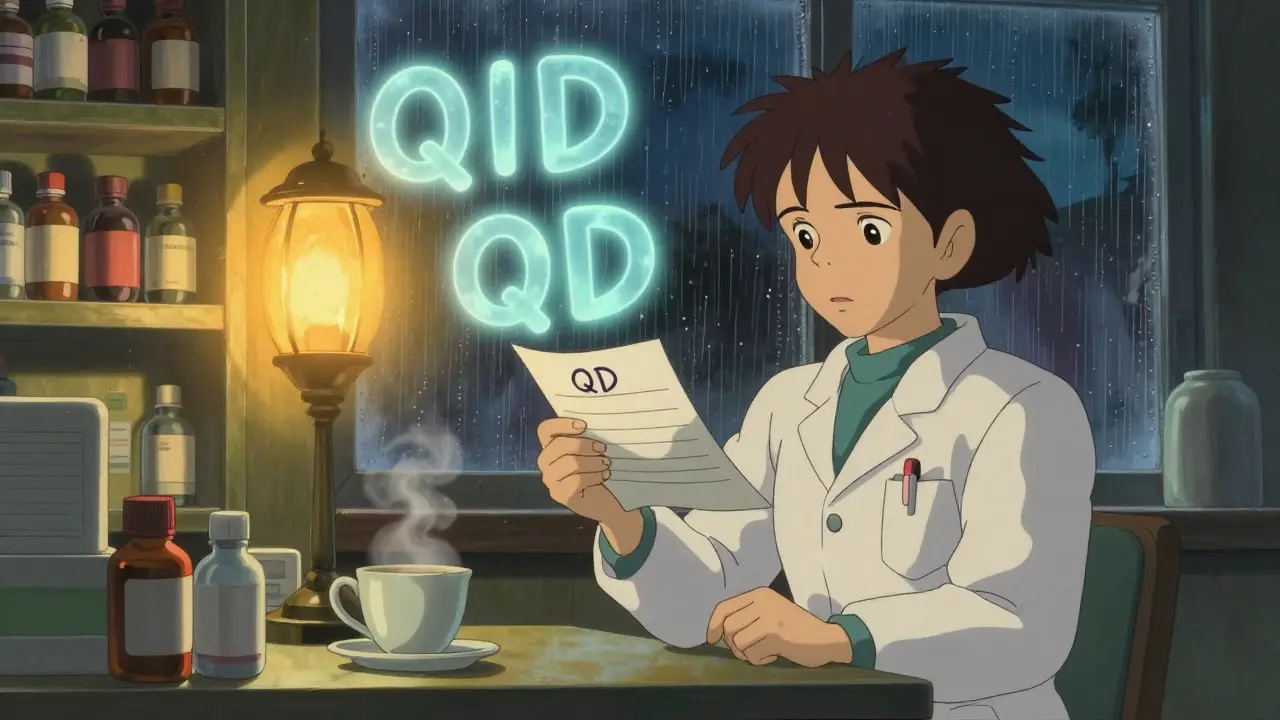
One wrong letter on a prescription can kill someone. It’s not science fiction-it’s a daily reality in hospitals, clinics, and pharmacies. A simple 'QD' meant to say 'once daily' gets misread as 'QID'-four times a day-and a patient overdoses. A handwritten 'MS' is confused for magnesium sulfate instead of morphine sulfate, triggering a cardiac arrest. These aren’t rare mistakes. They’re preventable-and they happen because of abbreviations that should have been banned years ago.
Why Abbreviations Are Deadly on Prescriptions
Medicine isn’t just about drugs. It’s about communication. When a doctor writes a prescription, it’s passed from hand to hand: nurse, pharmacist, technician. Each person reads it differently. Handwriting fades. Electronic systems misinterpret free-text entries. Abbreviations that seem obvious to one clinician are meaningless-or worse, misleading-to another.
The Joint Commission and the Institute for Safe Medication Practices (ISMP) have been warning about this since 2001. Their Do Not Use list isn’t a suggestion. It’s a mandatory safety rule for every accredited hospital in the U.S. and many abroad. And yet, errors keep happening-not because people are careless, but because old habits die hard.
The Top 5 Dangerous Abbreviations and What They Really Mean
Some abbreviations are so risky, they’ve caused hundreds of documented deaths. Here are the five most dangerous ones still showing up on prescriptions today-and what you should write instead.
- QD - This looks like 'once daily,' but it’s dangerously close to 'QID' (four times daily) or 'QOD' (every other day). In a 2018 analysis of nearly 5,000 medication errors, QD was responsible for 43% of all abbreviation-related mistakes. Write: 'once daily'
- U - Stands for 'unit.' But when handwritten, it looks like a '0' (zero), a '4' (four), or even a 'cc.' A diabetic patient was given 100 units of insulin instead of 10 because the 'U' was misread as '10.' Write: 'units'
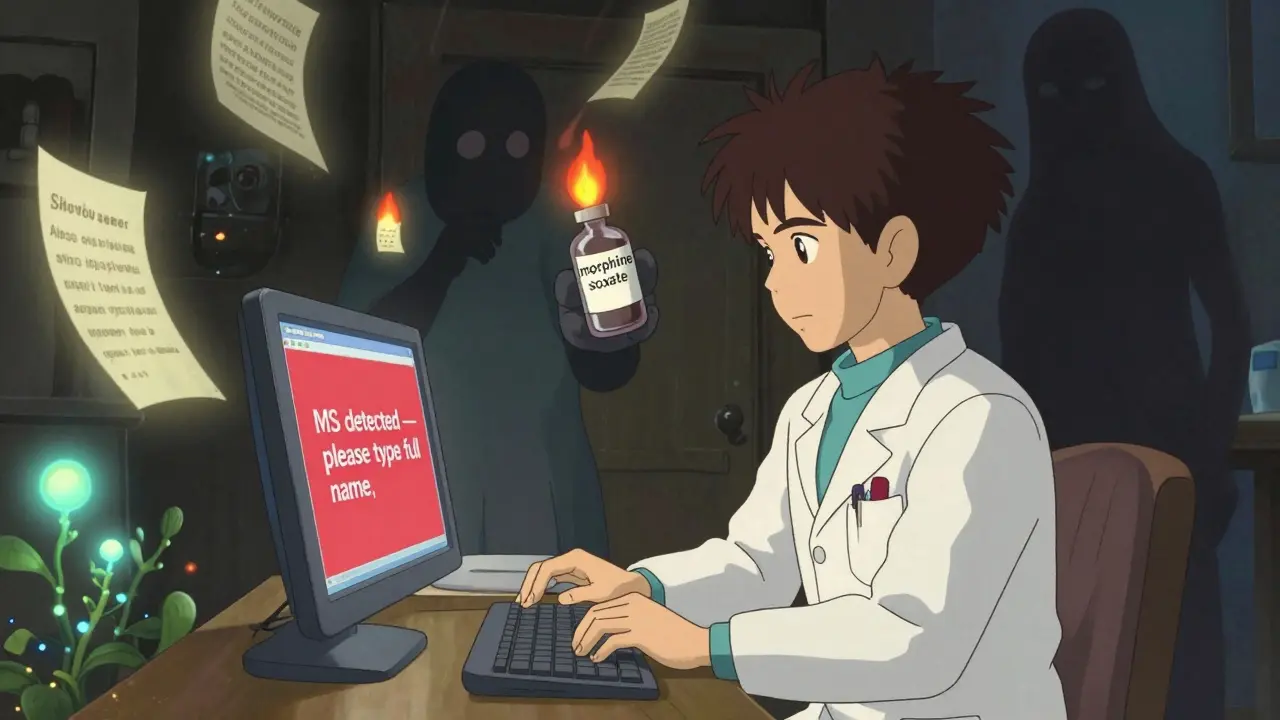
- MS or MSO4 - This is supposed to mean morphine sulfate. But it’s often confused with MgSO4 (magnesium sulfate), which is used for seizures and preeclampsia-not pain. Mixing them up can cause respiratory failure or cardiac arrest. Write: 'morphine sulfate'
- cc - Used to mean cubic centimeters. But it’s easily mistaken for 'U' (units) or 'mL.' In one case, a nurse gave 5 cc of a drug thinking it was 5 mL-when the prescription actually meant 5 units. The patient suffered severe hypoglycemia. Write: 'mL'
- IU - Short for 'international unit.' Sounds harmless, right? But it’s often read as 'IV' (intravenous) or '10' (ten). A patient was given an injection meant to be 10 IU of vitamin D-but the nurse thought it was 10 IV units. The overdose led to kidney damage. Write: 'international units'
These aren’t just theoretical risks. A 2022 survey of 1,843 pharmacists found that 63.7% had intercepted a dangerous abbreviation error in the past year. The top three? QD, U, and MS.
How EHRs Made Things Worse-Before They Fixed Them
Electronic health records (EHRs) were supposed to end these mistakes. And they did-sort of. A 2021 study showed EHRs cut abbreviation errors by 68%. But here’s the catch: 12.7% of errors still happened in EHRs. Why?
Because doctors still type free-text notes. 'Give MS 10 mg SC'-typed into a comment field, not a structured order. The system doesn’t flag it. The pharmacist sees 'MS' and thinks 'magnesium.' The nurse gives it. The patient crashes.
Worse, some EHRs still let users select 'QD' from a dropdown menu. Even in 2025, some systems don’t auto-block it. That’s like having a fire alarm that only goes off if you set the whole building on fire.
Real progress comes from hard stops-not soft reminders. Mayo Clinic implemented a system that refused to process any order with 'QD,' 'U,' or 'MS.' Instead, it forced prescribers to type out 'once daily,' 'units,' or 'morphine sulfate.' Within 18 months, abbreviation-related errors dropped by 92%.
Why Doctors Still Use These Abbreviations
If the risks are so clear, why do so many still write 'QD' and 'U'?
Tradition. Speed. Comfort.
A 2022 survey by the American Medical Association found that 43.7% of physicians over 50 still used banned abbreviations. For them, 'QD' was how they learned to write prescriptions in the 1980s. Changing feels like admitting they’re outdated. Younger doctors? Only 18.2% still use them. The generational gap is real.
Some doctors say it’s faster. But speed isn’t worth a patient’s life. And the truth? Once you switch, it’s not slower. It’s just different. After six months, 92% of physicians who switched said they didn’t miss the abbreviations.
And then there’s the culture problem. Nurses and pharmacists are trained to question unclear orders. But if the whole system rewards speed over clarity, why would a doctor slow down? The system needs to change-not just the individual.
What Works: Real Solutions That Save Lives
Simply telling people 'don’t use these' doesn’t work. You need systems.
Successful programs share three things:
- Hard stops in EHRs - If someone types 'MS,' the system won’t let them submit it unless they change it to 'morphine sulfate.'
- Mandatory training - Not a 10-minute video. A 90-minute session with real case studies. Show them the death reports. Show them the families.
- Real-time feedback - When a pharmacist catches an error, they notify the prescriber immediately. Not with a scolding email. With a call: 'Dr. Smith, I noticed you wrote 'U' for insulin. Could you please confirm the dose?'
One hospital in Manchester saw a 89% drop in errors after implementing all three. They didn’t need new tech. They just stopped accepting shortcuts.
Even community pharmacies are catching on. NHS England’s 2021 Safer Practice Notice made it clear: no abbreviations. Pharmacists now reject prescriptions with 'QD,' 'U,' or 'cc.' And patients? They’re safer.

What You Can Do-Even If You’re Not a Doctor
You don’t have to be a clinician to help prevent these errors.
- If you’re a patient: Always read your prescription label. If you see 'QD,' 'U,' or 'MS,' ask: 'Can you write that out fully?' You have the right to understand what you’re taking.
- If you’re a caregiver: Double-check doses. If a pill says '10 U' of insulin, verify it’s '10 units' and not '10 mL' or '10 IV.'
- If you’re in healthcare: Don’t just follow the rules. Challenge them. If your EHR still lets you pick 'QD' from a menu, report it. Push for change.
One pharmacist in Manchester recently intercepted a prescription for 'TAC 0.1% cream.' The doctor meant triamcinolone. The pharmacist thought it was Tazorac-a different drug used for acne. The patient had eczema. Giving the wrong cream could’ve caused severe skin damage. A quick call to the doctor fixed it. No harm done. But it could’ve been worse.
The Bigger Picture: This Isn’t About Typing-It’s About Trust
Every time a doctor writes 'MS' instead of 'morphine sulfate,' they’re not just being lazy. They’re saying: 'I trust you to know what I mean.' But medicine doesn’t work that way. We don’t trust intuition. We trust clarity.
The 'Do Not Use' list isn’t about policing doctors. It’s about protecting patients. And it works. A 2023 meta-analysis of 47 studies found that banning these abbreviations is one of the most effective ways to prevent medication errors-with just 12 facilities needing to adopt the policy to prevent one serious adverse event every year.
It’s not magic. It’s common sense. Write it out. Say it clearly. Don’t assume. Don’t guess. Don’t risk it.
Because in medicine, the difference between life and death isn’t always the drug. Sometimes, it’s the letter.
What are the most dangerous medical abbreviations to avoid on prescriptions?
The most dangerous abbreviations include 'QD' (can be confused with 'QID' or 'QOD'), 'U' (often mistaken for '0', '4', or 'cc'), 'MS' or 'MSO4' (confused with 'MgSO4'), 'cc' (confused with 'U' or 'mL'), and 'IU' (read as 'IV' or '10'). These have led to fatal overdoses and wrong-drug errors. Always write out 'once daily,' 'units,' 'morphine sulfate,' 'mL,' and 'international units' instead.
Why is 'QD' so dangerous on prescriptions?
'QD' is the most common abbreviation-related error, accounting for over 43% of cases in one major study. It looks too similar to 'QID' (four times daily) and 'QOD' (every other day). A patient meant to get a drug once daily might receive it four times, leading to overdose. Even in electronic systems, if 'QD' is still a selectable option, it’s a risk. Always write 'once daily' in full.
Can electronic health records (EHRs) prevent these errors?
EHRs reduce abbreviation errors by about 68%, but they don’t eliminate them. The problem comes from free-text fields where doctors type 'MS' or 'QD' without using structured dropdowns. The most effective systems use hard stops-blocking submission unless the full term is typed. Some EHRs now include AI tools that flag dangerous abbreviations in real time, but they’re not yet universal.
Why do some doctors still use banned abbreviations?
Many older doctors learned these abbreviations decades ago and find them faster or more familiar. A 2022 survey showed 43.7% of physicians over 50 still use them, compared to only 18.2% under 40. Resistance isn’t about ignorance-it’s about habit. But studies show that after six months of training and system changes, most clinicians adapt without difficulty.
What should I do if I see a dangerous abbreviation on my prescription?
Ask your pharmacist or doctor to clarify. Say: 'I see you wrote 'U'-does that mean units?' or 'Is 'MS' morphine sulfate or magnesium sulfate?' You have the right to understand your medication. Pharmacists are trained to catch these errors-so if they question it, trust them. Never assume.
Are these rules the same in the UK?
Yes. NHS England issued its Safer Practice Notice in 2021, aligning with the U.S. 'Do Not Use' list. UK pharmacists are required to reject prescriptions with 'QD,' 'U,' 'MS,' or 'cc.' The goal is the same: eliminate ambiguity to protect patients. The rules are global because the risks are universal.
I worked in a hospital pharmacy in Mumbai for 12 years, and I’ve seen this exact thing happen. A doctor wrote 'U' for insulin, and the nurse gave 100 units instead of 10. The patient went into a coma. We fixed it, but not before the family had to pay for months of rehab. Writing out 'units' takes two extra seconds. Two seconds can save a life. Please, just do it.
Bro in India we still use 'QD' because the handwriting is so bad even the AI can’t read it. If you type 'once daily' in Hindi script on a tablet, the system crashes. So yeah, we use 'QD' because it’s the only thing that works. Change the tech first, not the doctors.
It’s not about the abbreviations. It’s about incompetence. If you can’t write clearly or read a basic prescription, you shouldn’t be in medicine. This isn’t a system failure-it’s a human failure. People who still use 'MS' or 'U' are putting lives at risk because they refuse to adapt. No sympathy. No excuses. Just quit.
OMG I had a cousin who almost died because of 'QD' 😭 I cried for 3 days. My aunt had to quit her job to take care of him. This is so heartbreaking. We need to fix this NOW. Like, today. 🙏💖
It’s fascinating how language becomes a vector of harm in institutional systems. The abbreviation isn’t the problem-it’s the epistemological assumption that meaning is shared, that context is transparent, that the signifier can be reduced without consequence. The medical field operates on a linguistic economy of efficiency, but efficiency here is a euphemism for risk externalization. When we reduce 'morphine sulfate' to 'MS', we’re not saving time-we’re delegating cognitive labor to the reader, assuming their interpretive framework aligns with ours. But in a field where the stakes are life and death, that assumption is not just naive-it’s lethal. The solution isn’t just to spell things out-it’s to redesign the entire communicative architecture of care to make ambiguity impossible, not just discouraged.
Has anyone looked at how many errors happen because of EHRs auto-correcting 'mL' to 'ml' and then the system misreads it as 'MU'? I’ve seen it happen twice. The system thinks 'ml' is milliunits and auto-fills 1000 units. It’s not just abbreviations-it’s the software too.
This is why I love my pharmacist!! 💕 She always calls my doctor if something looks weird. Last week she caught 'IU' and asked if it was 'international units' or 'IV'-turned out it was a typo, but she saved me from a nightmare. 🌟 We need more pharmacists like her. Doctors, please let them do their job. They’re the real heroes. ❤️
The real issue is the lack of standardization in clinical informatics. The HL7 FHIR implementation in 87% of U.S. EHRs still permits free-text entry for medication orders without mandatory structured terminology binding. Until we enforce SNOMED CT or RxNorm canonical forms at the point of entry, we’re just performing performative safety. 'Write it out' is a Band-Aid on a hemorrhage. We need ontological governance, not semantics.
Look, this post is just virtue signaling. You didn’t mention that 70% of these errors happen during handoffs between shifts. That’s the real problem. Nurses are tired. Doctors are rushed. The abbreviation isn’t the villain-poor workflow design is. Fix the staffing ratios, fix the breaks, fix the shift changes. Stop blaming doctors for using 'QD' because they’ve been up for 24 hours. This isn’t about laziness-it’s about systemic neglect.
QD U MS stop it. Just write it out. Its that simple. 🤞
Of course people still use these abbreviations. They’re lazy. They don’t care enough to learn. And now they want us to feel bad for them? No. If you can’t follow basic safety rules after 20+ years of warnings, you don’t deserve to hold a stethoscope. This isn’t a culture problem-it’s a character problem. And if your EHR still lets you pick 'U' from a dropdown? That’s not a bug. That’s malpractice.