

Switching from one brand of digoxin to another might seem like a simple cost-saving move - but for patients taking this medication, it can be dangerous. Digoxin isn’t like most drugs. It’s a narrow therapeutic index (NTI) medication, meaning the difference between a therapeutic dose and a toxic one is razor-thin. The safe blood level range? Just 0.5 to 2.0 ng/mL. Go a little over, and you risk vomiting, irregular heartbeat, or even death. Go a little under, and your heart failure or atrial fibrillation could worsen. That’s why the way your body absorbs digoxin - its bioavailability - matters more than almost any other drug on the market.
Why Digoxin Is Different
Most generic drugs are considered interchangeable with their brand-name versions because they deliver the same active ingredient in the same amount. But digoxin breaks that rule. Even small differences in how quickly or completely the drug is absorbed from the gut can push levels out of the safe zone. The FDA treats digoxin like a new drug, not just another generic. To get approved, each generic version must prove it delivers the same amount of digoxin into the bloodstream as the brand-name Lanoxin - within a tight 80% to 125% range for both total exposure (AUC) and peak concentration (Cmax).
That sounds strict, and it is. But here’s the catch: bioequivalence is measured across a group of healthy volunteers. One person might absorb only 45% of the drug. Another might absorb 95%. The average might still fall within the acceptable range - and the FDA will approve it. But for the person who absorbs only 45%, that dose is useless. For the person who absorbs 95%, it’s potentially toxic. And if you switch from one generic to another, you might be switching from a low-absorber to a high-absorber without knowing it.
What Happens When You Switch Generics
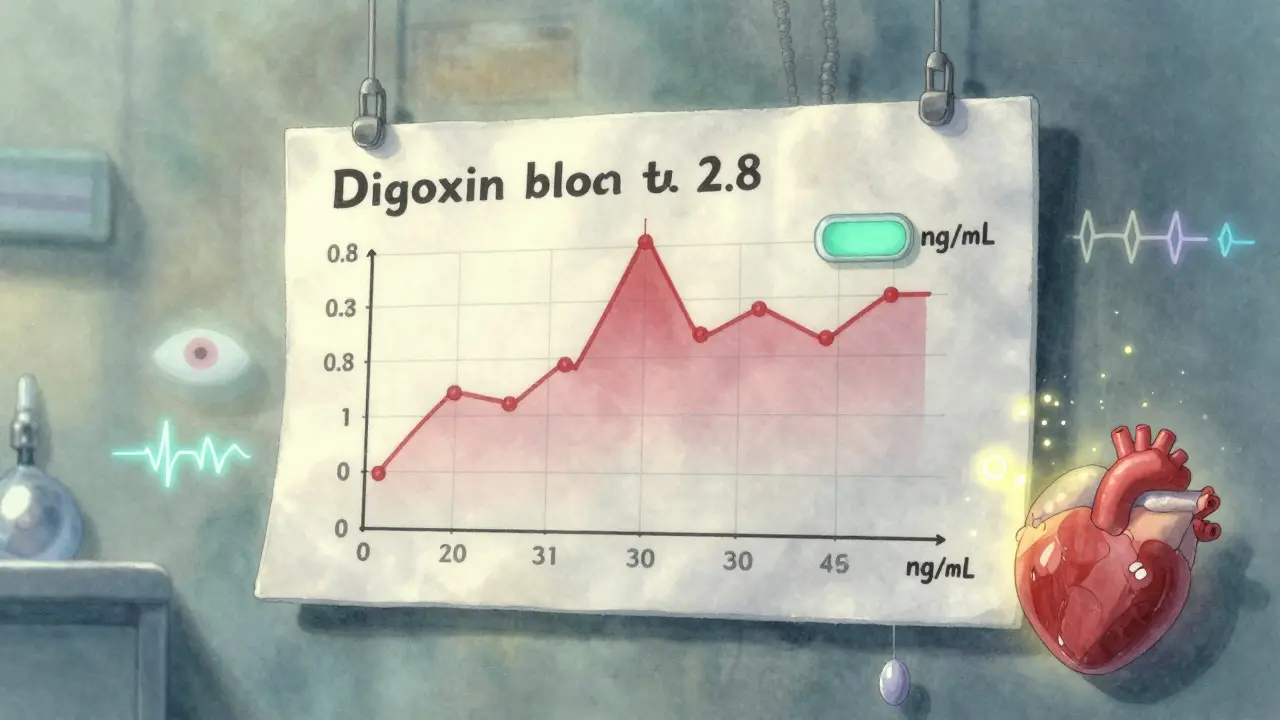
There are three FDA-approved generic digoxin tablets on the market. All carry an "AB" rating - meaning they’ve passed bioequivalence testing against Lanoxin. But no one has tested whether those three generics are bioequivalent to each other. That’s a huge gap. Imagine you’ve been stable on Generic A for six months. Your doctor switches you to Generic B because it’s cheaper. You feel fine at first. But three days later, you’re nauseous. Your heart races. Your doctor checks your digoxin level - it’s 2.8 ng/mL. Toxic. You’re lucky you didn’t have a cardiac arrest.
This isn’t hypothetical. Case reports show patients experiencing serum concentration changes of more than 25% after switching between generic manufacturers. One study in Estonia found that while generic digoxin was bioequivalent to Lanoxin overall, individual patients still had unpredictable absorption. Elderly patients - who make up most digoxin users - are especially vulnerable. Their kidneys don’t clear the drug as well. Their stomachs absorb it differently. They’re often on five or six other meds that interact with digoxin. A tiny shift in absorption can cascade into disaster.

Formulation Matters - Tablets vs. Elixir
Not all digoxin forms are the same. Tablets have bioavailability around 60% to 80%. The liquid form - digoxin elixir - is absorbed better, at 70% to 85% of the intravenous dose. That’s why switching from tablet to elixir, or vice versa, requires a dose adjustment. But even within tablets, differences in fillers, binders, and coating can change how fast the drug dissolves in your gut. One generic might release digoxin slowly. Another might release it all at once. The total amount might be the same, but the timing changes how your body handles it. That’s why the FDA requires stricter dissolution testing for digoxin than for most other generics.
When and How to Monitor
If you’re on digoxin, you need regular blood tests. Not once a year. Not when you feel bad. At key moments:
- 4 to 7 days after starting digoxin or changing the dose
- 3 to 5 days after switching to a different generic version
- Whenever your kidney function changes (common in older adults)
- If you start or stop another medication - especially diuretics, antibiotics, or antiarrhythmics
The blood test must be a trough level - drawn just before your next dose, when the drug is at its lowest. A level between 0.5 and 0.9 ng/mL is now considered optimal for heart failure patients. Higher levels don’t improve outcomes - they just increase risk. The American Heart Association and American College of Cardiology both say: stick with the same manufacturer if you can. If you must switch, test your levels right after.
What Clinicians Should Do
Doctors aren’t always aware of the risks. Many assume all generics are equal. But for digoxin, they’re not. Here’s what works:
- Prescribe by brand name when possible - especially for patients already stable
- If a generic is used, document the manufacturer and lot number
- Never switch manufacturers without checking serum levels
- Teach patients to recognize early signs of toxicity: nausea, loss of appetite, blurry yellow-green vision, dizziness, irregular pulse
- Use electronic health records to flag digoxin as an NTI drug - so pharmacists know not to substitute without approval
Some pharmacies still automatically substitute generics. That’s fine for most drugs. For digoxin, it’s a gamble. Pharmacists need to know: if a patient is on digoxin, don’t switch unless the prescriber says so.
The Bigger Picture
Digoxin is old. It’s cheap. It’s still used because it works - when used correctly. But its narrow window makes it one of the most dangerous drugs in common use. The FDA’s rules are good, but they’re not enough. Bioequivalence studies don’t capture individual variation. Real-world use does. We’ve seen patients who were stable on one generic, then hospitalized after a switch to another. We’ve seen families lose loved ones because no one checked the levels after a pharmacy substitution.
This isn’t about distrust in generics. It’s about precision. Digoxin isn’t a drug you can treat like aspirin. It needs attention. It needs monitoring. It needs consistency. If you’re taking it - or caring for someone who is - don’t assume the pill in your bottle is the same as the one last month. Check the label. Ask your pharmacist who made it. And if anything changes, get your blood tested.
The science is clear: digoxin generics can be safe. But only if we treat them like the high-risk medication they are.
Can I switch between different digoxin generics without checking my blood levels?
No. Even though each generic is approved as bioequivalent to the brand-name drug, no studies prove they’re equivalent to each other. Switching between manufacturers can cause your digoxin level to jump or drop by more than 25%, which can lead to toxicity or treatment failure. Always check your serum level 3 to 5 days after switching.
Why is digoxin more dangerous than other generics?
Digoxin has a narrow therapeutic index - the gap between a helpful dose and a toxic one is very small. Small changes in how much of the drug enters your bloodstream can push you out of the safe range. Most drugs have a wider safety margin, so minor absorption differences don’t matter. With digoxin, they do.
Should I ask my doctor to prescribe Lanoxin instead of a generic?
If you’re stable on a generic and your levels are in the safe range, there’s no need to switch. But if you’ve had problems before - like nausea, dizziness, or irregular heartbeats - or if you’re elderly or have kidney issues, asking for Lanoxin may reduce risk. Some doctors will prescribe the brand if you explain your concerns. Insurance may require prior authorization, but it’s worth trying.
How often should digoxin levels be checked?
Check levels when you start digoxin, after any dose change, after switching manufacturers, and whenever your kidney function changes or you start a new medication. For stable patients on the same generic, testing every 6 to 12 months is reasonable - but if anything changes, test immediately.
Can I take digoxin elixir instead of tablets to avoid absorption issues?
Elixir is absorbed more reliably than tablets, but it’s not a fix-all. It’s still a narrow therapeutic index drug. Switching from tablet to elixir requires a dose adjustment - usually a 10% to 20% reduction. Never switch forms without checking your level and talking to your doctor.
Are there any signs I should watch for at home?
Yes. Watch for nausea, vomiting, loss of appetite, blurry or yellow-green vision, dizziness, confusion, or an irregular or very slow heartbeat. These can be early signs of toxicity. If you notice any of these, contact your doctor immediately - don’t wait for your next appointment.
Digoxin is such a sneaky drug I swear it's out to get elderly people
My grandma switched generics and ended up in the ER with a heart rhythm that looked like a seizure on the monitor
They didn't even check her levels until she was blue in the face
Pharmacies need to stop treating this like ibuprofen
It's absolutely unacceptable that the FDA allows this! In America, we demand precision in pharmaceuticals! The fact that bioequivalence is determined by group averages-rather than individual pharmacokinetics-is a national disgrace! This is why our healthcare system is crumbling! Every single generic substitution must require prior authorization, and pharmacists who substitute without consent should lose their licenses! This isn't just negligence-it's criminal!
My uncle was on digoxin for years and never had an issue until they switched him to a cheaper generic without telling him
He got dizzy while walking the dog and fell-broke his hip
Turns out his levels spiked to 2.9
He’s fine now, but it scared the hell out of us
Just because it’s cheap doesn’t mean it’s safe
Always ask your pharmacist who made it-write it down
My mom’s on digoxin and I made her keep a little notebook
Brand, lot number, date switched, how she felt
It’s such a small thing but it’s saved us from so many panic calls
Doctors don’t always remember this stuff
But we can remember for them
It’s wild how something so old and cheap can be so dangerous
Like a 1950s car with no seatbelts-still runs fine, but one bump and it’s over
People think old = safe, but digoxin is the opposite
It’s not the drug’s fault-it’s how we treat it
We need to stop treating it like a commodity and start treating it like a precision tool
The FDA’s bioequivalence standards for digoxin are fundamentally inadequate. While the 80–125% AUC and Cmax range is statistically acceptable for population-level approval, it fails to account for inter-individual variability in gastrointestinal absorption, renal clearance, and drug interactions-particularly in geriatric populations with polypharmacy. A 25% fluctuation in serum concentration is not merely a statistical outlier-it is a clinically significant event that can precipitate life-threatening arrhythmias. This necessitates mandatory therapeutic drug monitoring protocols for all digoxin prescriptions, regardless of formulation or manufacturer. The current system is a public health liability.
Digoxin isn’t just a drug-it’s a high-wire act without a net 🎪
One pill, one tiny shift in your gut, one change in kidney function… and boom-you’re dancing with death
It’s like playing Russian roulette with your heart
And pharmacies? They’re spinning the cylinder like it’s a vending machine
We need a red flag system-like for warfarin or lithium-so when someone tries to swap digoxin, the system SCREAMS "STOP!"
Every pharmacist, every prescriber, every patient deserves to know: this isn’t aspirin. This is a scalpel. Handle with reverence.
India makes better generics than the US ever could. Why are you Americans so afraid of cheap medicine? This is fear-mongering. If your body can't handle it, it's your fault, not the drug's.
It’s funny how we treat drugs like they’re interchangeable widgets
But the body isn’t a factory line-it’s a living, breathing, wildly unpredictable system
Digoxin reminds us that medicine isn’t just chemistry
It’s biology. It’s timing. It’s trust
Maybe the real problem isn’t the generics-it’s that we’ve forgotten how to listen to the body’s whispers before they turn into screams
My aunt switched generics and started seeing yellow halos around lights-classic digoxin toxicity
She thought it was just old age
Turns out her levels were off the charts
Now she only takes Lanoxin and I make sure her pharmacy knows it
Don’t let cost be the reason someone loses their vision-or their life 💛
From a pharmacokinetic standpoint, the inter-generic variability in digoxin bioavailability is a perfect storm of formulation heterogeneity-dissolution profiles, excipient interactions, and gastric pH-dependent release kinetics all contribute to non-linear absorption curves that defy population-based bioequivalence thresholds. The 80–125% window is statistically valid but clinically myopic. We need individualized pharmacogenomic-guided dosing and mandatory TDM post-switch. The current regulatory framework is archaic and dangerous. This isn’t just about generics-it’s about systemic failure in NTI drug oversight.