
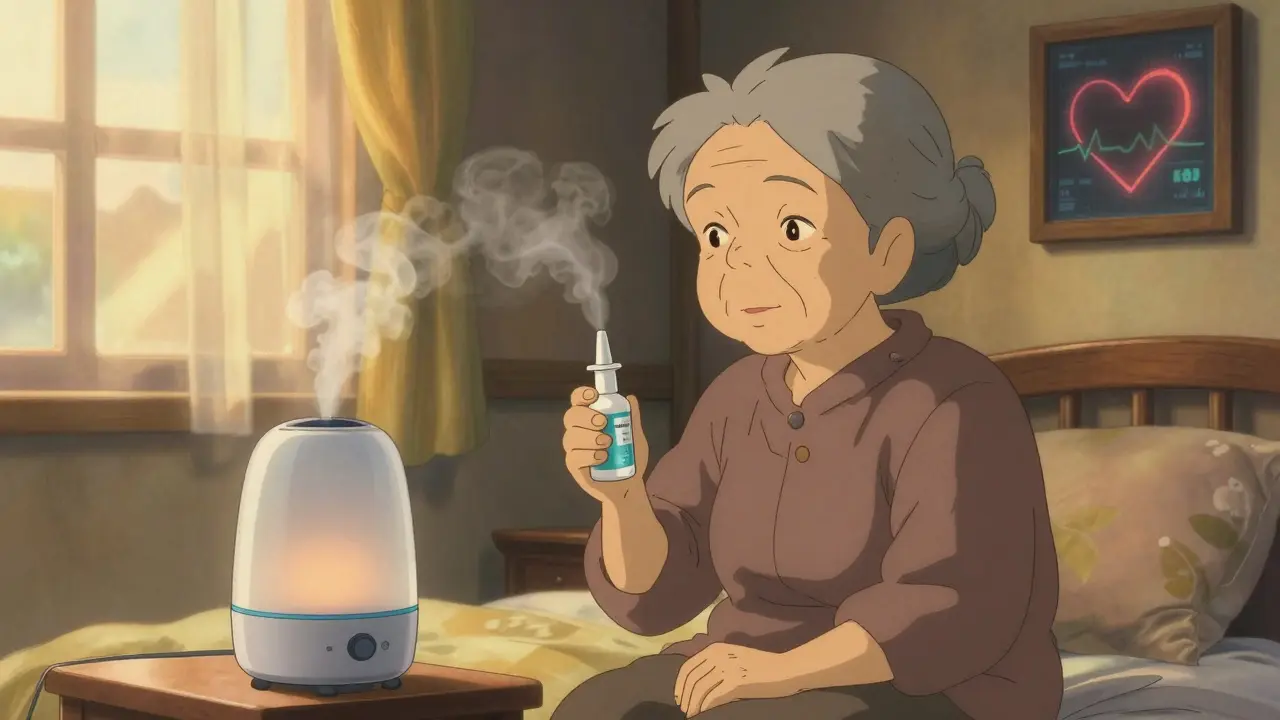
Decongestant Risk Checker
This tool helps you understand your risk when considering decongestant medications. Based on the latest medical guidelines, it assesses how decongestants may affect your heart health based on your current blood pressure and medical history.
If you have heart disease or high blood pressure, taking a common cold medicine might be riskier than you think. Decongestants are everywhere-shelves at the pharmacy, corner stores, even some multi-symptom cold pills. They promise quick relief from a stuffy nose. But for people with heart conditions, that relief can come with serious, even life-threatening, side effects.
How Decongestants Work-and Why That’s Dangerous for Your Heart
Decongestants like pseudoephedrine and phenylephrine work by tightening blood vessels. That’s why your nose clears up: the swollen tissues shrink. But that same effect doesn’t stay in your nose. These drugs travel through your bloodstream and tighten blood vessels everywhere-including those around your heart and throughout your body.
This vasoconstriction forces your heart to work harder. Blood pressure rises. Your heart rate can spike. For someone with healthy arteries and a normal heart, this might cause little more than a slight jittery feeling. But for someone with heart disease, uncontrolled hypertension, or a history of heart attack or stroke, this extra strain can trigger dangerous events: irregular heart rhythms, chest pain, or even a heart attack.
It’s not just oral pills. Nasal sprays like oxymetazoline (Afrin) and naphazoline are often seen as safer because they’re local. But even these aren’t risk-free. A 2015 case report documented a 40-year-old man who developed life-threatening heart failure after using too much nasal spray. His blood pressure soared, his heart couldn’t pump properly, and he ended up in emergency care. That’s not a rare outlier-it’s a warning.
Which Decongestants Are the Most Risky?
Not all decongestants are the same. The two most common active ingredients are pseudoephedrine and phenylephrine. Both are found in products like Sudafed and many store-brand cold remedies.
Pseudoephedrine has been around since the 1920s. It’s more effective at relieving congestion than phenylephrine, but it also has stronger effects on blood pressure. A 2005 meta-analysis confirmed that even standard doses of pseudoephedrine can raise systolic blood pressure by a small but measurable amount. That might sound minor-until you’re already at 160/95.
Phenylephrine became more popular after pseudoephedrine was moved behind the pharmacy counter in 2005 due to its use in making methamphetamine. But it’s not safer for your heart. A documented case in 2023 showed a 5-year-old girl developing high blood pressure after taking recommended doses of phenylephrine. Her pressure returned to normal only after stopping the medication. If it can happen in a child on the right dose, imagine what happens in an adult with heart disease.
Topical sprays may seem less harmful, but they’re not harmless. Studies show they can still increase heart rate. And if you use them too often or too long-something people often do when congestion won’t go away-you risk rebound congestion and even more systemic absorption.
Who’s at the Highest Risk?
Medical experts agree: certain heart conditions make decongestants especially dangerous. The American Heart Association and Mayo Clinic both list these as absolute red flags:
- Uncontrolled high blood pressure (hypertension)
- Heart failure
- History of heart attack or stroke
- Arrhythmias (irregular heartbeat)
- Prinzmetal’s angina (coronary artery spasms)
Even if your blood pressure is controlled with medication, you’re not off the hook. A slight rise in pressure can push you over the edge. One study of nearly 10,000 people hospitalized after a heart attack found that those who took NSAIDs or decongestants while sick were more than three times as likely to have another heart attack within a week.
Why? Because being sick already stresses your heart. Your body fights infection with inflammation, your heart rate climbs, and your blood vessels tense up. Adding a decongestant on top of that is like pouring gasoline on a fire.
What About Alternatives?
You don’t need decongestants to feel better. There are safer ways to manage congestion, especially if you have heart disease.
- Saline nasal sprays-no medication, just salt water. They flush out mucus and irritants without affecting your blood pressure.
- Humidifiers-adding moisture to the air helps loosen congestion naturally.
- Guaifenesin (Mucinex)-this expectorant helps thin mucus so you can cough it up. It doesn’t constrict blood vessels.
- Steam inhalation-breathe in warm steam from a bowl or shower. It’s simple, free, and effective.
- Elevating your head-sleeping with an extra pillow reduces nighttime congestion.
The European Journal of General Medicine says it plainly: decongestants only treat symptoms. They don’t cure the cold or flu. If your symptoms are mild, skipping them altogether is often the wisest choice.
What Should You Do If You’ve Already Taken One?
If you have heart disease and you’ve taken a decongestant-especially if you didn’t know it was risky-don’t panic. But do pay attention.
Watch for these signs:
- Sudden, severe headache
- Chest pain or pressure
- Shortness of breath that’s worse than your usual symptoms
- Heart palpitations or a racing, fluttering heartbeat
- Dizziness or fainting
If any of these happen, call your doctor or go to urgent care. Don’t wait. These could be early signs of a dangerous reaction.
If you’re unsure whether your cold medicine contains a decongestant, check the label. Look for these ingredients: pseudoephedrine, phenylephrine, oxymetazoline, naphazoline, or ephedrine. If you see any of them, and you have heart disease, stop taking it.

Why Are These Warnings Still Ignored?
Many people don’t realize decongestants are dangerous for their heart because they’re sold over the counter. They assume, “If it’s on the shelf, it must be safe.” But that’s not how it works. The FDA requires warning labels on all decongestants for people with high blood pressure or heart disease. Pharmacists are trained to screen customers buying pseudoephedrine-ask about your heart, your meds, your history.
But not everyone asks. And not everyone listens. Too many people take a decongestant thinking, “I just need to get through the week.” The cost of that decision isn’t just a few days of discomfort-it could be a trip to the ER, a longer hospital stay, or worse.
Bottom Line: Safer Choices for a Healthier Heart
If you have heart disease or high blood pressure, avoid decongestants. Period. The risks far outweigh the benefits. Your nose might be stuffy, but your heart is more important.
Stick to saline sprays, humidifiers, rest, and hydration. Talk to your pharmacist before buying anything labeled “cold and flu.” Ask: “Does this contain a decongestant? Is it safe for someone with heart disease?”
And if you’re ever unsure-skip it. Your body is already fighting hard. Don’t make your heart fight harder than it has to.
Thank you for this. I had no idea nasal sprays could do this to your heart. My dad’s on blood pressure meds and he’s been using Afrin for years. I’m showing him this right now. 💔🫂
USA medical system is so overhyped. In India we just use turmeric steam and call it a day. No pills needed.
My grandma used to say ‘if it ain’t broke, don’t fix it.’ She never took anything for colds. Just slept it off. Guess she knew something.
It’s fascinating how the FDA allows these drugs to be sold OTC when the pharmacological mechanism is essentially a beta-adrenergic agonist with systemic vasoconstrictive properties. The regulatory oversight here is embarrassingly lax. A 2005 meta-analysis? Please. The real data is buried in post-marketing surveillance studies from the 90s that no one reads. This isn’t negligence-it’s systemic commodification of public health.
And don’t get me started on phenylephrine’s efficacy. It’s a placebo with a patent. The FDA even admitted in 2021 that it’s no better than saline for nasal decongestion. Yet it’s everywhere. Why? Because Big Pharma doesn’t care if you die-they care if your insurance pays for the next bottle.
Meanwhile, the real solution-steam, hydration, rest-is free, accessible, and has zero side effects. But you can’t patent a humidifier. So instead, we get $12 bottles of chemical aggression disguised as ‘relief.’
And yes, I’ve seen the ER reports. I’ve seen the charts. The rise in cardiac events in January? It’s not flu season. It’s Sudafed season.
Next time you reach for that bottle, ask yourself: who profits if I have a heart attack? Hint: it’s not your pharmacist.
Wow, another liberal panic piece. You’re telling me I can’t take a decongestant because my heart’s ‘weak’? My grandpa fought in Korea, worked 60-hour weeks, drank whiskey with breakfast, and never took a pill for a cold. He lived to 92. You people are making weaklings out of Americans. Get off the couch. Breathe through your mouth. Stop whining.
And don’t even get me started on ‘saline sprays.’ That’s what you call medicine now? Salt water? Next you’ll tell me to hug a tree for pneumonia.
Real men don’t need a humidifier. They need grit. And if your heart can’t handle a little pseudoephedrine? Maybe you shouldn’t be on Reddit-you should be on oxygen.
So let me get this straight-you’re telling people with heart disease to avoid decongestants… but you’re not telling Big Pharma to stop pushing these drugs? Or the FDA to ban them? Or the stores to stop putting them next to candy? No. You’re putting the burden on the patient. Classic. You want to help? Ban the damn things. Don’t just make people feel guilty for being sick.
And ‘check the label’? Ha. Half the people reading this don’t know what ‘pseudoephedrine’ means. They see ‘cold relief’ and grab it. You think they’re gonna read the tiny disclaimer? Please. This isn’t education. It’s performative concern.
Also, why is ‘Mucinex’ safe? Because it’s got ‘ex’ in the name? That’s not science. That’s marketing. You’re just swapping one snake oil for another.
It’s wild how we treat illness like a bug to be exterminated instead of a signal. Your body’s not broken-it’s trying to tell you something. A stuffy nose? That’s your immune system doing its job. You don’t need to silence it. You need to support it. Rest. Hydrate. Breathe. Let the fever come. Let the mucus flow. Your heart isn’t the enemy. The hustle culture that tells you ‘push through’ is.
And yet… we’re sold pills like they’re medals of honor. ‘I fought my cold and won!’ Nah. You just delayed the healing. And now your heart’s paying the price.
Maybe the real illness isn’t the cold. It’s the belief that we’re entitled to instant relief.
So let me get this straight: I can’t take Sudafed but I can take 3 Advil and a Red Bull? 😂
Also, who wrote this? The CDC’s new poet laureate? ‘Pouring gasoline on a fire’? Bro. I came for decongestants, not a TED Talk.
But hey… if I’m gonna die from a cold, at least I’ll die with style. 🙃
Wait-so oxymetazoline in Afrin can cause heart failure?? 😱 I’ve been using it for 8 years… I need to check my blood pressure tomorrow. Thank you for this. I’m deleting my cold meds app now. 🙏
My sister has heart failure and she told me last week she took DayQuil because she ‘just needed to get through work.’ I screamed. She cried. We’re both crying now. This is real. Please share this.
There’s a quiet tragedy in how we’ve turned healing into a product. We don’t want to rest. We don’t want to sit with discomfort. We want a pill. A spray. A button to press. And the system? It’s happy to sell us the illusion of control.
But the heart doesn’t care about deadlines. It doesn’t care about your Zoom meeting. It just beats. And if you force it to beat harder? It will break. Quietly. Alone. While you’re scrolling through TikTok wondering why you feel so tired.
Maybe the real medicine isn’t in the pharmacy. Maybe it’s in silence. In stillness. In saying no.
So if I have heart disease, I can’t take decongestants… but I can take 2000mg of acetaminophen daily? Or drink 6 energy drinks? Or smoke? Or sit on the couch for 12 hours? This whole thing feels like victim-blaming with a side of ‘eat your vegetables.’
Also, why is Mucinex ‘safe’? It’s just guaifenesin. What’s that even do? Sounds like a chemical from a sci-fi movie.
I’m not convinced. This feels like fearmongering dressed up as care.
so i just realized i took a cold med with phenylephrine last week 😳 i have high bp but i thought it was ‘safe’ bc it was ‘newer’… i’m so dumb. thanks for the wake up call. going to drink water and nap now. 🥲
you people are so dramatic. in india we just use ginger tea and sleep. no pills. no fear. no drama. why you need so much medicine? your body is weak. not the cold.