

When a patient gets sick after taking a new medication, how do you know if the drug actually caused it? It’s not always obvious. Maybe it was the infection they already had. Or the other pills they’re on. Or just bad luck. This is where the Naranjo Scale comes in. It’s not fancy. It doesn’t need a computer. But it’s one of the most trusted tools doctors and pharmacists use to figure out if a drug really caused an adverse reaction - and not something else.
What Exactly Is the Naranjo Scale?
The Naranjo Scale is a simple 10-question checklist designed in 1981 by a team of researchers led by Dr. Carlos Naranjo. It was created because, after the thalidomide disaster in the 1960s, regulators realized they needed a consistent way to tell if a drug caused harm - not just guess. Before this, reports were all over the place. One doctor might say a reaction was definitely from the drug. Another might say it was the patient’s age. The Naranjo Scale brought order to that chaos. It works by asking yes-or-no questions about the patient’s history and the timing of symptoms. Each answer gets a score: +2, +1, 0, or even -1. Add them all up, and you get a total that tells you how likely the drug caused the reaction. No guesswork. No opinions. Just numbers.How the Scoring Works - Step by Step
Here’s how the 10 questions break down, with what each answer means:- Were there previous reports of this reaction? +1 if yes. Otherwise 0.
- Did the reaction happen after the drug was given? +2 if the timing fits. -1 if it happened before.
- Did symptoms improve after stopping the drug? +1 if yes.
- Did the reaction return when the drug was given again? +2 if yes. -1 if it got worse.
- Are there other possible causes? -1 if another explanation is strong. +2 if there aren’t any.
- Was a placebo used to test the reaction? -1 if placebo caused it. +1 if the reaction only happened with the real drug.
- Was the drug level in the blood toxic? +1 if yes.
- Did higher doses make the reaction worse? +1 if yes.
- Has the patient had this reaction before with the same drug? +1 if yes.
- Is there objective proof the reaction happened? +1 if lab tests, imaging, or other data confirm it.
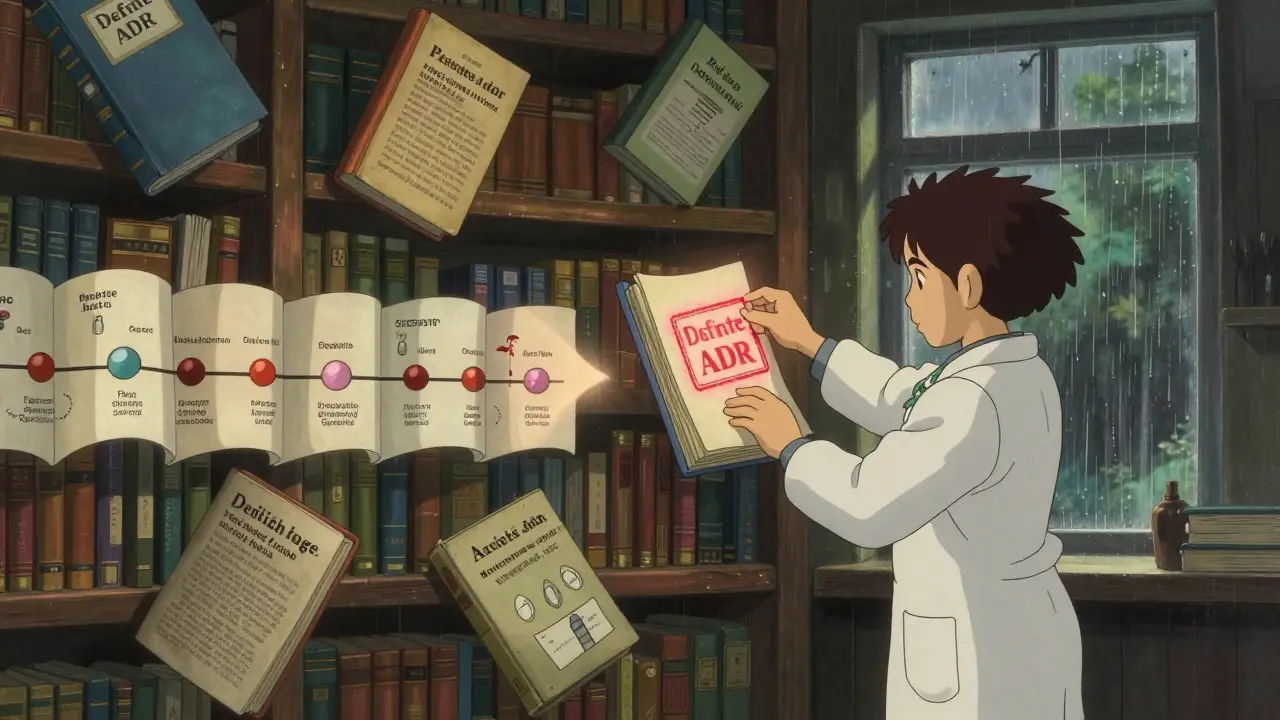
- 9 or higher = Definite ADR - the drug almost certainly caused it.
- 5 to 8 = Probable ADR - likely the drug, but not 100% certain.
- 1 to 4 = Possible ADR - maybe the drug, maybe not.
- 0 or lower = Doubtful - the reaction was probably caused by something else.
Why It’s Still Used Today - Even in 2026
You’d think a 40-year-old tool would be outdated. But it’s not. In 2023, a study in Cureus showed that 78% of published drug safety reports still used the Naranjo Scale. Why? Because it’s simple, cheap, and works anywhere - from a rural clinic to a big hospital pharmacy. It’s built into systems like the FDA’s Adverse Event Reporting System (FAERS) and the WHO’s global drug safety program. In North America, 92% of pharmacovigilance teams use it. In Europe, it’s 85%. Even though newer tools exist, most still start with Naranjo because it forces you to think through every possibility. A pharmacist in Massachusetts General Hospital told a Reddit thread: “We use it daily. It stops us from jumping to conclusions. If we don’t check all 10 questions, we don’t file the report.” That’s the power of structure.
Where It Falls Short - The Real Limitations
It’s not perfect. And anyone who uses it regularly knows the flaws. The biggest problem? Rechallenge. Question 4 asks if giving the drug again made the reaction come back. But if the reaction was severe - say, liver failure or a dangerous skin rash - you’d never give it back. Ever. So you mark “don’t know.” That knocks your score down from “definite” to “probable.” That’s not wrong. But it’s frustrating. Question 6 is even trickier. It asks if a placebo caused the reaction. But giving someone a fake pill to see if they get sick again? That’s unethical today. No ethics board would allow it. So most clinicians just skip it or guess. That adds error. Another issue? Polypharmacy. Most older patients take five or six drugs. The Naranjo Scale only looks at one drug at a time. If someone takes warfarin, lisinopril, and a new antibiotic - and then gets bleeding - which one caused it? The scale can’t tell. That’s why newer tools like the Liverpool Scale were developed. But they’re more complex. So Naranjo stays as the first step. And it doesn’t handle modern drugs well. Biologics, immunotherapies, gene therapies - their reactions can show up weeks or months later. The Naranjo Scale was built for pills that cause reactions within hours or days. It doesn’t fit.How People Are Fixing It - Digital Tools and Updates
People aren’t giving up on the scale. They’re upgrading it. In 2023, researchers built a Python-based calculator that automates the scoring. You answer the 10 questions in a form. The app checks for errors - like if you gave a +2 for “no” - and instantly gives you the total. One study found it cut assessment time from 11 minutes to 4.2 minutes. Errors dropped from 28% to 9%. Some EHR systems like Epic now auto-fill four of the 10 questions using patient data - like when the drug was prescribed, lab results, or past reactions. That removes guesswork. Even the International Council for Harmonisation (ICH) is updating the scale. In June 2024, they proposed replacing the placebo question with one about therapeutic drug monitoring - like checking blood levels of the drug. That’s more realistic, safer, and still scientific.Who Uses It - And Who Should Learn It
You won’t find most family doctors using the Naranjo Scale every day. But you’ll find it everywhere else:- Hospital pharmacists - they use it to report reactions to safety teams.
- Pharmacovigilance officers - at drug companies, they use it to analyze case reports.
- Regulatory agencies - the FDA and EMA require structured assessments like this.
- Nursing and pharmacy students - they learn it in class. A 2023 survey found 72% mastered it after five practice cases.
What to Do If You Suspect an Adverse Reaction
Here’s a quick guide:- Stop the drug - if it’s safe to do so. Don’t wait.
- Document everything - when the drug started, when symptoms began, what they were, how severe.
- Check for alternatives - infection? New supplement? Change in diet?
- Use the Naranjo Scale - go through all 10 questions. Even if you’re unsure, write down why.
- Report it - to your hospital’s safety team, or to your country’s drug safety agency.
Final Thought - Why It Still Matters
The Naranjo Scale isn’t glamorous. It’s not AI-powered. It doesn’t predict the future. But it forces you to slow down. To look at the evidence. To question your assumptions. In a world where drugs are getting more complex and patients are taking more of them, that’s not a weakness - it’s a lifeline. It’s the reason we know that certain antibiotics cause tendon tears. That statins can trigger muscle damage. That some blood pressure drugs cause dry coughs. All because someone, somewhere, used a simple 10-question form to connect the dots. It’s not the end of causality assessment. But for now, it’s still the best place to start.Is the Naranjo Scale still reliable in 2026?
Yes. Despite being over 40 years old, the Naranjo Scale remains one of the most widely used and validated tools for assessing drug reactions. Studies from 2023 show it’s still used in 78% of published adverse drug reaction reports. Its reliability comes from its structured, objective approach - not from being new. While newer tools exist for complex cases, Naranjo is still the standard starting point in hospitals, pharmacies, and regulatory agencies worldwide.
Can the Naranjo Scale be used for any drug?
It works best with traditional oral medications where reactions appear within hours or days. It’s less reliable for biologics, immunotherapies, or gene therapies, where side effects can appear weeks or months later, or are irreversible. The scale was designed in the 1980s, before these modern treatments existed. For those cases, newer tools like the Liverpool Scale or AI-based models are better suited - but Naranjo is still often used as a first filter.
Why is rechallenge so hard to answer on the Naranjo Scale?
Rechallenge means giving the drug back to see if the reaction happens again. But if the reaction was serious - like anaphylaxis, liver failure, or a life-threatening rash - it’s unethical and dangerous to re-administer the drug. Most clinicians mark this as “don’t know,” which lowers the final score. This is a known flaw. Many now treat a “don’t know” on rechallenge as a reason to downgrade from “definite” to “probable,” even if other answers are strong.
Is the placebo question still used in practice?
Rarely. Question 6 asks if a placebo caused the reaction - meaning you’d give a fake pill to see if symptoms return. But intentionally giving a placebo to trigger a reaction violates modern medical ethics. Most clinicians skip this question or mark it as “don’t know.” In fact, international regulators proposed replacing it in 2024 with a question about therapeutic drug monitoring - checking blood levels instead - which is safer and more practical.
Can I use the Naranjo Scale at home?
No. The scale requires clinical knowledge to interpret answers correctly. For example, knowing whether an alternative cause is “sufficient” or whether lab results confirm a reaction needs medical training. It’s designed for healthcare professionals to use in clinical or reporting settings. Patients should never try to self-assess. If you suspect a drug reaction, talk to your doctor or pharmacist - don’t rely on online calculators.
How long does it take to learn the Naranjo Scale?
Most healthcare professionals can learn the basics in 2-4 hours of training. But true proficiency takes practice. Studies show that after 5-10 supervised assessments, users start to get consistent results. After 20-30 cases, they’re typically reliable. Nursing and pharmacy students often master it after working through 3-5 real cases. Digital tools have made learning faster - with error rates dropping by 70% when using automated calculators.
Next Steps - What to Do If You’re New to This
If you’re a student, pharmacist, or nurse just starting out:- Download a free Naranjo Scale worksheet from Nebraska ASAP or Fiveable - they’re widely used in training.
- Practice with 5 real case reports from your hospital’s safety database (if available).
- Use the open-source Python calculator on GitHub to test your answers - it flags mistakes instantly.
- Don’t memorize the scores. Understand the logic: Did the drug come first? Did it stop when the drug stopped? Is there another explanation?