
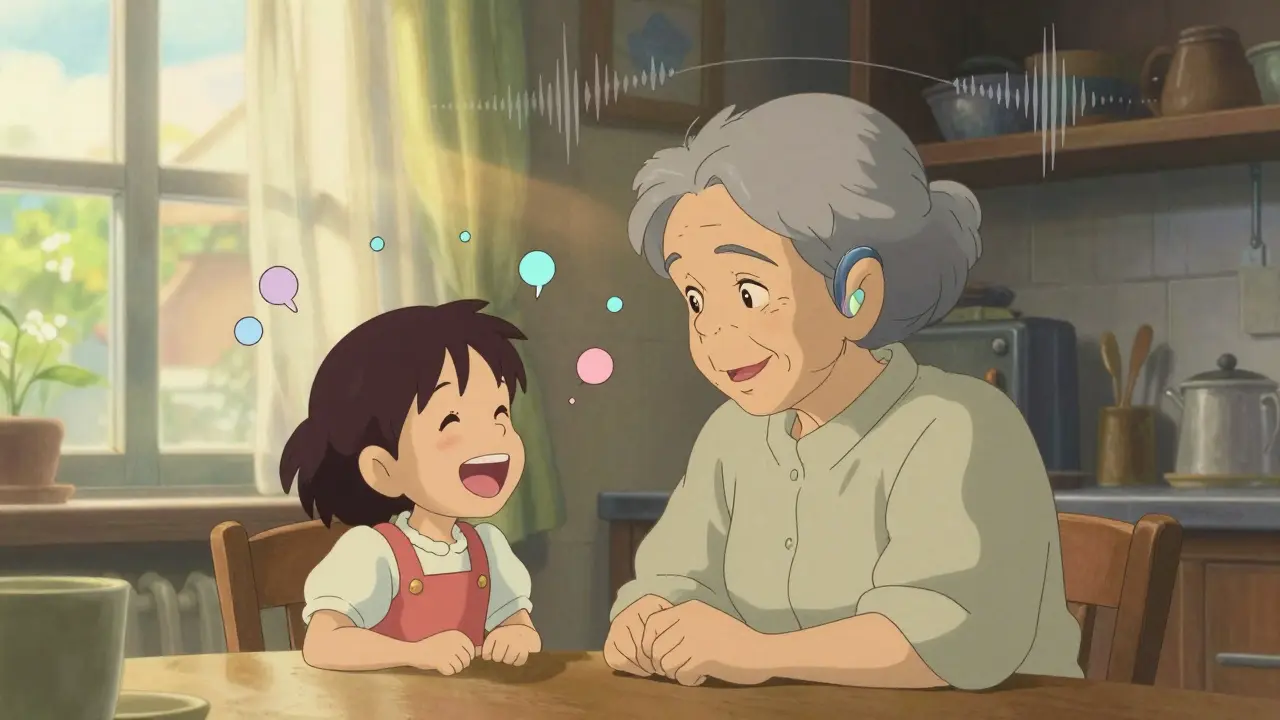
By the time you’re 70, there’s a better than 40% chance you’re struggling to hear conversations in a crowded room. Not because you’re not paying attention - but because your ears have changed. This isn’t just about turning up the TV. It’s presbycusis, the medical term for age-related hearing loss, and it’s quietly reshaping how millions of older adults live, connect, and stay safe.
What Exactly Is Presbycusis?
Presbycusis (pronounced prez-buh-KYOO-sis) isn’t just "getting a little deaf." It’s a specific, irreversible change in the inner ear. The tiny hair cells in your cochlea - the ones that turn sound waves into electrical signals your brain understands - start dying off. You’re born with about 16,000 of them. And once they’re gone, they don’t grow back. After age 30, you lose roughly 1% per year. By 70, that’s a significant chunk gone.
This loss doesn’t hit all frequencies equally. High-pitched sounds go first. That means the voices of children, birds singing, the beep of a microwave, or the "s" and "th" sounds in speech become fuzzy or disappear. You might hear someone talking but not understand what they’re saying. That’s because consonants carry most of the meaning in speech - and they’re the highest frequencies.
It’s slow. So slow that many people adapt without realizing it. They stop joining group dinners. They ask their spouse to repeat things. They turn the TV up so loud it wakes the neighbors. By the time they see a doctor, the hearing loss has been creeping for years.
Why It’s More Than Just Missing Words
Ignoring presbycusis doesn’t just make conversations harder - it rewires your brain and your life.
Studies show untreated hearing loss increases the risk of dementia by up to 50%. Why? When your brain has to work overtime just to catch a word, it steals energy from memory and thinking. Over time, this constant strain may accelerate cognitive decline. A 2020 Lancet Commission report called hearing loss one of the top modifiable risk factors for dementia.
Then there’s isolation. People with hearing loss are 5.3 times more likely to withdraw from social events. Why? Because listening in a restaurant, at a family gathering, or even on the phone becomes exhausting. A 2022 JAMA study found depression rates jumped 32% in older adults with unaddressed hearing loss. Forty-one percent avoid gatherings altogether.
And safety? It’s a real concern. Nearly 4 in 10 older adults with untreated hearing loss have missed a fire alarm, car horn, or doorbell. That’s not just inconvenient - it’s dangerous.
What’s Really Causing It?
It’s not just aging. Genetics play a big role - up to half of all cases are linked to inherited traits like GRHL2 and GJB2 gene variations. But environment and health conditions push it faster.
Noise exposure over decades is a major culprit. Working in construction, being around loud music, or even just living near a busy road for years adds up. Exposure to sounds over 85 decibels for more than 8 hours a day increases your risk by 40%.
Chronic health issues make it worse. Diabetes raises your risk by 28%. High blood pressure? That’s a 23% bump. Smoking? Adds another 15%. These conditions damage blood flow to the inner ear, starving the hair cells of oxygen.
And here’s the kicker: most people never get screened. Only 15% of primary care doctors routinely check hearing, even though guidelines recommend it. That means many people go years without knowing they’re losing their hearing - until it’s too late to fully reverse the damage.

Amplification Isn’t Just About Volume - It’s About Clarity
The good news? You don’t have to live with it. Amplification - mostly through hearing aids - works. But not like the old boxy devices from the ‘90s.
Modern hearing aids are tiny computers. They don’t just make everything louder. They use digital signal processing to boost speech frequencies while reducing background noise. Directional microphones focus on the person in front of you. Bluetooth connects directly to your phone, TV, or even your smart home devices.
Studies show properly fitted hearing aids improve speech understanding by 40-60% in quiet places and 25-40% in noisy ones. Eighty-five percent of users report better communication. That’s life-changing.
But here’s the problem: only 30% of people who could benefit actually use them. Why? Cost. Fit. Frustration.
Prescription vs. Over-the-Counter: What’s Right for You?
Since 2022, the FDA allowed over-the-counter (OTC) hearing aids - a game-changer for accessibility. You can now buy them without a doctor’s visit.
OTC models cost $200-$1,000 per pair. Brands like Jabra Enhance Select and Eargo are popular. They’re good for mild to moderate loss and work well for people who want simplicity.
But if your hearing loss is more advanced, or you struggle in noisy environments, prescription aids are better. These are custom-fitted by an audiologist. Premium models like Phonak Paradise, Oticon More, and Signia Styletto range from $1,800 to $3,500 per ear. They offer 16-64 frequency channels, AI-powered noise reduction, and real-time adjustments.
Consumer Reports rates Oticon More and Widex Moment as top performers for prescription aids. Jabra leads OTC. But here’s the catch: even the best device won’t help if it doesn’t fit right. About 45% of people who quit using hearing aids say it’s because they’re uncomfortable or don’t seal properly in the ear.
Getting Started: What to Do Next
If you’re noticing signs - asking people to repeat themselves, turning up the TV, avoiding social events - here’s your action plan:
- Get tested. See an audiologist. Don’t rely on phone apps. A full hearing evaluation maps your exact loss pattern.
- Try before you buy. Most clinics offer a 30-60 day trial. Use it. Wear the aids daily. Test them in different places - at home, in the car, at a cafe.
- Expect a learning curve. Your brain needs time to relearn how to process sound. It takes 4-6 weeks to feel natural. Don’t give up after a week.
- Get it fine-tuned. The first fitting is just the start. You’ll need 2-4 follow-ups to adjust volume, noise reduction, and directionality.
- Use support tools. Many modern aids come with apps. You can adjust settings on your phone, stream calls, even track how much you’re using them.
And don’t forget: Medicare Advantage plans now cover hearing aids for 28 million beneficiaries as of 2024. Check your plan. You might be eligible for partial or full coverage.

Real People, Real Results
On Reddit’s r/HearingAids community, stories pour in. One user, "HearingHopeful42," said after 15 years of pretending to hear, her Phonak Audeo M-312s let her hear her granddaughter’s laughter again. Another said he finally understood his wife’s jokes - something he’d missed for a decade.
But it’s not perfect. Many users complain about wind noise. Others struggle with Bluetooth pairing. Some say restaurants are still too loud. That’s why fitting and follow-up matter. A bad experience isn’t the device’s fault - it’s often the fit or programming.
What’s Next for Hearing Technology?
The field is moving fast. AI is now built into hearing aids. Signia’s Nx platform reduces listening effort by 20% by predicting what you’re likely to hear next. ReSound’s LiNX Quattro tracks your movement and social activity - and can alert your doctor if you’ve been isolated for days.
Direct-to-consumer hearing tests are growing. Beltone’s SoundClear app has over 1.2 million downloads. But don’t skip the audiologist. Apps can’t replace a full diagnostic test.
Global sales of hearing aids are projected to hit $14.7 billion by 2030. That’s not just business - it’s a public health shift. The World Health Organization warns that without action, 1.5 billion people will have hearing loss by 2050.
Don’t Wait Until It’s Too Late
Presbycusis isn’t something you have to live with. It’s not a normal part of aging - it’s a treatable condition. The earlier you act, the better your brain can adapt. Dr. Frank Lin from Johns Hopkins says treating hearing loss at 60 instead of 70 could reduce dementia risk by 8-10% over ten years.
There’s no pill for it. No surgery. Just smart amplification and the willingness to ask for help.
If you’re noticing changes in your hearing - or you’re worried about a parent, partner, or friend - don’t wait. Get tested. Try a device. Reconnect. Your brain, your relationships, and your safety are worth it.
Is presbycusis the same as general hearing loss?
No. Presbycusis is a specific type of hearing loss caused by aging, primarily affecting the inner ear’s hair cells. Other types of hearing loss can be caused by noise exposure, ear infections, medications, or injury. Presbycusis is progressive, sensorineural, and bilateral - meaning it affects both ears equally and gets worse over time.
Can hearing aids restore my hearing to normal?
No, they can’t restore hearing to what it was when you were younger. But they can restore communication. Most users report 40-60% improvement in understanding speech in quiet settings and 25-40% in noisy ones. The goal isn’t perfect hearing - it’s being able to join conversations again without stress.
Why do some people stop using hearing aids?
The top reasons are poor fit (45%), discomfort (30%), and not hearing well in noisy places like restaurants (25%). Many people expect immediate results, but it takes weeks for the brain to adjust. Skipping follow-up appointments increases the chance of giving up. A good audiologist will fine-tune the device over time.
Are over-the-counter hearing aids any good?
For mild to moderate hearing loss, yes - and they’re a huge step forward in accessibility. Brands like Jabra Enhance Select and Eargo have high user satisfaction. But if you have complex hearing loss, struggle in noise, or need custom programming, prescription aids with professional fitting are more effective. OTC devices are not a replacement for a full hearing evaluation.
Can hearing loss lead to dementia?
Yes - untreated hearing loss is linked to a 50% higher risk of dementia. The brain has to work harder to process sound, which drains resources needed for memory and thinking. Studies show treating hearing loss early can reduce this risk by up to 10% over a decade. It’s one of the most preventable causes of cognitive decline.
How often should I get my hearing checked?
The American Speech-Language-Hearing Association recommends a baseline test at age 50, then every two years after that. If you notice changes - like needing the TV louder or struggling in groups - get tested sooner. Early detection means better outcomes.
Does Medicare cover hearing aids?
Original Medicare (Parts A and B) does not cover hearing aids. But many Medicare Advantage plans (Part C) now include hearing benefits. As of 2024, 28 million beneficiaries have coverage - check your specific plan. Some plans cover part of the cost, others cover full devices.
What should I look for in a hearing aid provider?
Look for an audiologist (not just a salesperson) who offers a trial period, multiple follow-up appointments, and remote tuning options. Ask if they work with your insurance. Avoid providers who push the most expensive model without testing your specific needs. A good provider will focus on your lifestyle - not just the device.
Man, I never realized how much I was missing until I got my hearing aids. Used to think my wife was just mumbling, turns out she was saying "I love you" and I heard "I loo... uh...". After 10 years of pretending, I finally went in. Best decision ever. Now I hear my grandkids laugh, birds outside, even the damn microwave beep. My brain feels less tired. Like I got a new lease on life. Seriously, if you’re hesitating-just go. No regrets. Not even a little one.
So let me get this straight-we’ve got a medical condition that increases dementia risk by 50%, costs society billions in lost productivity, and yet the first solution the system offers is a $900 gadget you can buy off Amazon like it’s a new phone case? Brilliant. We’ll fix the crisis of cognitive decline by turning hearing into a consumer product. Next up: antidepressants in vending machines. At least with hearing aids, you don’t have to pay for therapy to deal with the guilt of not hearing your own mother say your name for the last time.
Dear sir/madam, I am writing to express my profound concern regarding the normalization of presbycusis as an inevitable consequence of aging. In India, our elders maintain sharp auditory acuity well into their 80s through Ayurvedic herbal formulations, daily ear massage with sesame oil, and strict avoidance of Western noise pollution. The pharmaceutical-industrial complex has weaponized this condition to sell expensive devices. You are being sold a solution to a problem they created.
Been there. Got the cheap OTCs. Didn’t work. Went to audiologist. Got custom ones. Took 3 weeks to stop feeling like my head was in a tin can. Now I hear my cat purring from the other room. Weird, right? But yeah. It’s not magic. It’s science. And it’s worth the hassle. Don’t let cost scare you-Medicare Advantage might cover it. Just ask. No shame.
The FDA’s OTC approval is a regulatory failure. Without diagnostic precision, users are being exposed to acoustic trauma from improperly calibrated amplification. The industry exploits vulnerability. This is not healthcare-it is commodified senescence.
my wife keeps telling me to get hearing aids but i just turn the tv up louder. also i think she’s mad at me because i don’t hear her when she says "we need to talk". she says it real quiet like. i think she’s just being dramatic.
As someone who’s spent the last decade researching neuroplasticity and auditory rehabilitation, I can’t emphasize enough how critical early intervention is. The brain doesn’t just lose hearing-it rewires itself to compensate, and those compensatory pathways become entrenched. Once you’ve trained your brain to fill in gaps with assumptions, even the best hearing aids can’t fully reverse the perceptual distortion. That’s why trials are non-negotiable. You need to give your neural networks time to relearn. And yes, the apps that track usage? They’re not just marketing fluff-they’re clinically validated behavioral feedback loops. If you’re not using them, you’re missing half the treatment.
I bought my mom a Jabra Enhance last year. She cried the first time she heard her own voice through the app. Said it sounded like she was talking to herself from 10 years ago. Now she calls me every Sunday just to tell me about the birds outside. I didn’t know she loved birds. Turns out, she just couldn’t hear them before. This isn’t about gadgets. It’s about coming back to life. Thank you for writing this.
got my aids last month and now i hear my own farts. like really clearly. not sure if that’s a feature or a bug but its definitely a vibe
The notion that presbycusis is merely a sensory deficit overlooks its ontological implications. The auditory cortex, deprived of stimulus, undergoes synaptic pruning, thereby altering the phenomenological structure of lived experience. One does not merely lose the ability to hear; one loses the capacity to be heard.
Let’s be honest: 85% user satisfaction is a marketing lie. It’s based on self-reported surveys from people who’ve already spent $3,000 and are too emotionally invested to admit it’s not working. The real failure rate is closer to 60%. Most people don’t return them because they’re too ashamed. And don’t get me started on the ‘trial period’-it’s a 30-day trap designed to make you feel guilty for not adapting fast enough.
my dad got his hearing aids last year and now he’s talking to the dog like it’s his best friend. i swear he asked it if it wanted to go for a walk. i didn’t know he even liked the dog. turns out he just couldn’t hear it barking before. now he’s like a whole new person. i cried. like, full ugly cry. this is so much more than hearing. it’s connection. thank you for writing this.
my neighbor got a pair of those new ones. they look like tiny earbuds. i asked him if he can hear his own heartbeat now. he said yes. i think he’s lying. but i’m jealous.
Used to work construction. 20 years of jackhammers. Now I can’t hear my own damn grandson say "Grandpa" unless he’s screaming it from across the room. Got the OTCs. Thought I was a hero. Turned out they just made everything louder-including my tinnitus. Went to an audiologist. Got real ones. Now I hear the wind in the trees. And my grandson’s voice. Worth every penny. Even if my wife still says I’m too loud on the phone.