

When a brand-name drug loses its patent, you’d expect a flood of cheaper generic versions to hit the market. But sometimes, the same company that made the original drug starts selling its own version under a generic label. That’s an authorized generic. It’s not a copycat. It’s the real thing - same active ingredient, same factory, same packaging, just without the brand name. And it’s becoming a smarter, more strategic tool in the pharmaceutical game.
What Authorized Generics Really Are
Authorized generics aren’t approved through the usual generic drug pathway (ANDA). They’re made by the original brand company and sold under a generic name, often right after the patent expires. Think of it like a car maker releasing a no-frills version of its own model, just without the logo. The FDA has tracked these since 1999, and between 2010 and 2019, there were 854 authorized generic launches. Most came after the first traditional generic hit the market - not before. That’s not an accident. It’s calculated.Why wait? Because brand manufacturers don’t want to kill their own sales too early. If they launch an authorized generic before competitors enter, they risk losing the premium price they’re still charging. But once generics start competing, the brand’s sales begin to drop fast. That’s when they roll out their own generic version - to keep a piece of the pie. In markets where a generic company gets 180 days of exclusivity, about 70% of authorized generics launched during or right before that window. They’re not trying to replace their brand. They’re trying to beat the competition at its own game.
Why Oral Pills Dominate the Market
Not all drugs are created equal when it comes to authorized generics. The data shows a clear pattern: oral solid dosage forms - tablets and capsules - make up the vast majority. Why? Because they’re easier and cheaper to copy. The chemistry is simpler. The manufacturing process is well-understood. The FDA approves ANDAs for these faster. That’s why 80% of authorized generics launched between 2010 and 2019 were pills or capsules. Complex drugs like injectables or biologics? Not so much. Until now.That’s changing. Starting in 2025, high-revenue biologics like ustekinumab and vedolizumab are losing patent protection. These are drugs used for autoimmune diseases and cancer, each bringing in billions annually. Biosimilars - the biologic equivalent of generics - are gearing up to enter. And brand companies are watching closely. If they can launch an authorized version of these complex drugs before biosimilars arrive, they can control the transition. The $25 billion opportunity in oncology and immunology by 2029 isn’t just for biosimilars. It’s also a potential playing field for authorized generics.
The Decline of Delay Tactics
For years, brand companies used authorized generics as a weapon to delay real competition. They’d wait until the first generic was approved, then launch their own version - often squeezing out the competitor before it could build market share. This tactic was called “authorized generic ambush.” It worked. But it’s fading.According to RAPS in June 2025, the practice of delaying authorized generic launches is declining. Why? Two big reasons. First, regulators are watching. Policymakers are pushing back against tactics that slow down price drops. Second, the market is changing. With so many blockbuster drugs losing patents between 2025 and 2030 - drugs worth $217 billion to $236 billion in annual sales - brand companies can’t afford to play games. They need to move fast, not stall.
There’s also a reputational cost. When patients and insurers see the same company selling the same pill under two different labels - one expensive, one cheap - it looks bad. The public is more aware of drug pricing now than ever. Companies that appear to be gaming the system risk backlash.

The FDA’s New Push for U.S. Manufacturing
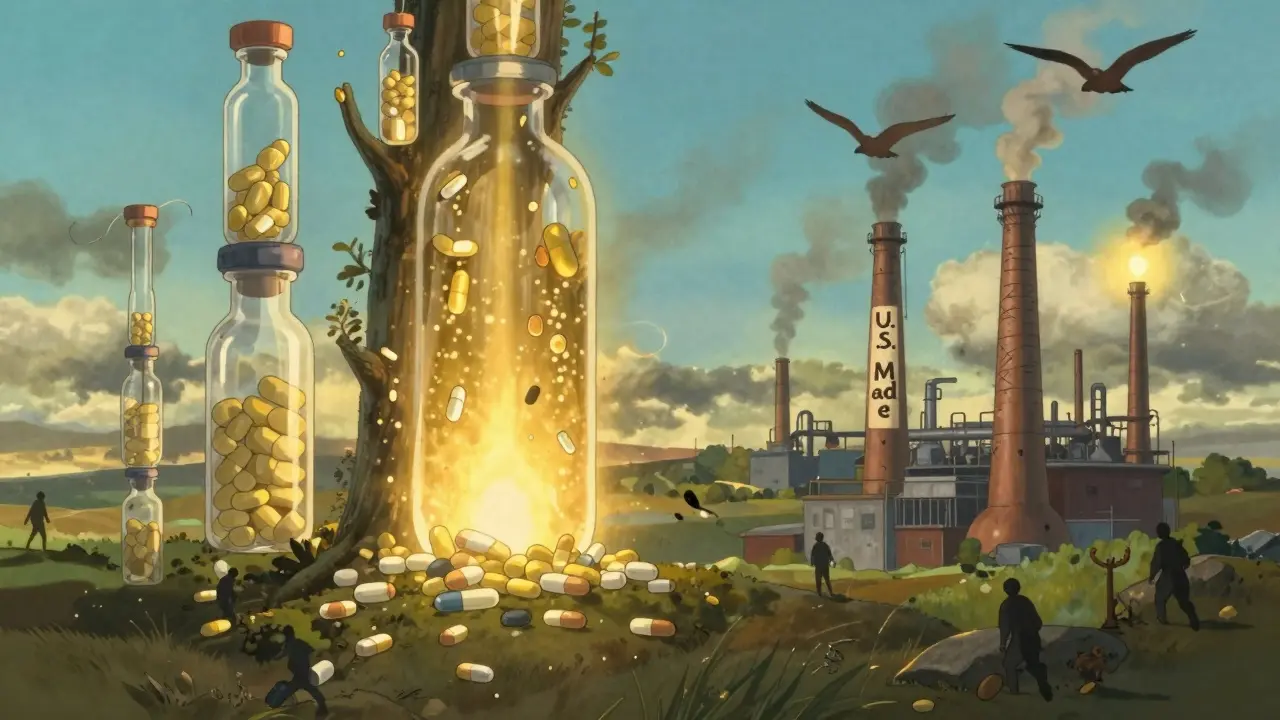
In October 2025, the FDA launched a pilot program that could reshape the entire generic drug landscape. It prioritizes FDA reviews for generic drugs - including authorized generics - that are made and tested entirely in the United States. This isn’t just about speed. It’s about security. After years of supply chain disruptions and reliance on overseas manufacturing, the U.S. government wants drugs made closer to home.This changes the math for brand companies. If you’re thinking about launching an authorized generic, you now have a choice: make it overseas (cheaper, slower approval) or make it in the U.S. (more expensive, faster approval). For high-volume, low-margin pills, the cost might still win. But for complex drugs - where timing matters more than cost - the faster path could be worth the extra expense. This program could make U.S.-based authorized generics more common, especially for drugs where delays could mean lost sales.
Market Growth and the Billion-Dollar Wave
The generic drug market isn’t just growing - it’s exploding. The U.S. market alone is projected to hit $196.9 billion by 2034, up from $138.2 billion in 2024. Globally, it could reach $700-800 billion by the early 2030s. Why? Because a tidal wave of patents is expiring. From 2025 to 2030, drugs worth over $200 billion will go generic. That’s not just a market shift. It’s a financial earthquake.And it’s not just about price. Generics saved the U.S. healthcare system $467 billion in 2024 alone. Over the past decade, that’s $3.4 trillion in savings. Biosimilars added $20.2 billion in 2024. These aren’t small numbers. They’re reshaping how insurers, hospitals, and patients think about treatment.
Authorized generics are part of this story. They don’t always lower prices as much as traditional generics - sometimes they’re priced just below the brand. But they still increase competition. And in markets with only one or two generic players, an authorized generic can be the spark that drives prices down further.
Regulatory Pressure and the Future of Pricing
Policymakers aren’t just watching. They’re acting. A 2025 JAMA Health Forum study found that extending patent exclusivity beyond expiration costs commercial insurers $2.5 billion and Medicare $2.4 billion over three years - mostly on drugs like imatinib and celecoxib. That’s money that could have gone to cheaper generics. The study’s message is clear: delay tactics hurt patients and payers.Authorized generics, when used to extend market control, contribute to this problem. But they also offer transparency. Because they’re listed by the FDA, regulators can track them. That’s something they can’t always do with traditional generics that use shell companies or offshore manufacturing.
The future likely holds more scrutiny. Expect more pressure on brand companies to launch authorized generics sooner - not later. More rules around pricing transparency. Possibly even limits on how long a company can sell its own branded version after a generic enters the market. The goal? Faster access to affordable drugs.
What This Means for Patients and Providers
For patients, authorized generics mean more options. Sometimes, the cheapest version of a drug isn’t the traditional generic - it’s the authorized one. Pharmacists can substitute it without a new prescription. Insurers often prefer it because it’s still the same drug, just cheaper than the brand.For doctors, it’s about choice. If a patient can’t afford the brand, and the traditional generic isn’t available, an authorized generic might be the only affordable option. In rural areas or places with limited pharmacy access, that matters.
But there’s a catch. Not all authorized generics are cheaper. Some are priced just below the brand, making them barely better than the original. Patients need to ask: Is this the lowest price available? Is there a traditional generic? A biosimilar? A mail-order option? Don’t assume “generic” means “cheapest.”
The Bottom Line
Authorized generics aren’t going away. But their role is changing. They’re no longer just a weapon to crush competition. They’re becoming a tool for managing transition - a way for brand companies to stay relevant as the market shifts toward affordability and transparency. The days of strategic delays are ending. The era of speed, domestic production, and regulatory accountability is here.The future belongs to companies that adapt. Those who use authorized generics to build trust, not block competition. Those who invest in U.S. manufacturing to meet new FDA standards. Those who understand that in a world of $467 billion in annual savings from generics, the real profit isn’t in holding onto high prices - it’s in staying part of the solution.
Are authorized generics the same as regular generics?
Yes and no. Authorized generics are chemically identical to the brand-name drug - same active ingredient, same manufacturer, same factory. The only difference is the label. Regular generics are made by different companies that copy the brand’s formula. Authorized generics are made by the brand company itself, sold under a generic name. Both are FDA-approved and equally safe.
Why would a brand company sell its own generic?
To stay in the game after the patent expires. If they don’t, a competitor might capture most of the market. By launching their own generic, they keep a share of sales, avoid losing all revenue, and sometimes even undercut the competition. It’s a way to control the transition from brand to generic without disappearing from the market.
Are authorized generics cheaper than the brand?
Usually, but not always. They’re typically priced lower than the brand, but sometimes only slightly - just enough to look like a deal. In some cases, a traditional generic from another company is even cheaper. Always compare prices at your pharmacy. The label says “generic,” but that doesn’t guarantee the lowest price.
Can authorized generics delay cheaper generics from entering the market?
Yes, they’ve done that in the past. A brand company could wait until the first generic was approved, then immediately launch its own version - often forcing the first generic out of business because the brand’s version had better distribution and brand recognition. But this tactic is declining. Regulators and public pressure are making it riskier and less effective.
Will the FDA’s new U.S. manufacturing program affect authorized generics?
Absolutely. The FDA’s new pilot program gives faster approval to generics made entirely in the U.S. That means brand companies might choose to make their authorized generics domestically - even if it costs more - just to get them to market faster. This could lead to more authorized generics being made in the U.S., especially for high-demand or complex drugs.
Do authorized generics help lower drug prices overall?
They can, but not always. In markets with little competition, an authorized generic can push prices down by adding another option. But if it’s priced too close to the brand, it doesn’t help much. Their real value is in increasing market transparency and giving regulators better data on how drugs are priced and distributed. Over time, that leads to fairer pricing.
Honestly, I’ve seen this play out with my dad’s cholesterol med. Brand was $400, generic was $12, but the authorized one? $8. Same pill, same bottle, just no fancy logo. Pharmacist didn’t even blink when she swapped it. Sometimes the system works - if you know where to look.
Oh, so now we’re romanticizing corporate sleight-of-hand? ‘Authorized generic’? What a sanitized euphemism for ‘We’re still milking you, but now we’re wearing a mask.’ The FDA’s new U.S. manufacturing push? Cute. Until you realize it’s just another subsidy for Big Pharma to keep their profit margins intact while pretending to play nice.
I appreciate how you framed this - it’s not just about price, it’s about trust. When I was on biologics for my autoimmune condition, the authorized generic was the only version my insurance covered without a 6-week appeal. Same drug. Same results. But the fact that it came from the same lab as the brand? That gave me peace of mind. Transparency isn’t just regulatory - it’s emotional.
Let us not be naive. The entire pharmaceutical ecosystem is a meticulously engineered illusion. The brand-name company, the authorized generic, the ‘competing’ generic - all are often subsidiaries of the same conglomerate. The FDA’s ‘pilot program’? A distraction. The real question: Why does the U.S. still allow a single entity to control both the original and its ‘copy’? This is not competition. It is monopoly dressed in bureaucratic clothing.
Authorized generics are not a solution - they are a diagnostic tool for systemic failure. When the originator can legally produce a lower-cost version of its own drug, it reveals that the original pricing was never about R&D - it was about rent extraction. The fact that this is still framed as ‘innovation’ or ‘market strategy’ is the real scandal. We’re not fixing pricing; we’re just rebranding exploitation.
wait so if the brand company makes the generic… then why do they even bother with the brand name anymore? like… if i can get the same thing for 1/5th the price… why would i ever pay more? also i think this is why my pharmacy keeps switching my script back and forth - it’s not about me, it’s about who’s paying what. kinda wild.
Have you ever thought about how many people die because they can’t afford the brand… and then the authorized generic comes in… and it’s still too expensive? I mean… it’s not ‘cheaper’ - it’s just less obvious that you’re being gouged. The real tragedy? We’re celebrating a 15% discount as if it’s justice. It’s not. It’s damage control.
It’s fascinating, isn’t it? The authorized generic - a paradox in pharmaceutical form: the original, made available as the copy; the monopolist, masquerading as the democratizer. It mirrors the very nature of late-stage capitalism - where the system doesn’t collapse, it simply rebrands its exploitation as ‘choice.’ And we, the consumers, are left applauding the illusion of agency.
So let me get this straight - the same company that charged $500 for a pill now sells the exact same pill for $8 and gets a pat on the back? And you call this progress? This isn’t innovation. This is a magic trick where the rabbit was never gone to begin with. I’m tired of being told to be grateful for crumbs disguised as a feast
Look - I get the cynicism. But if you’re a patient who can’t afford insulin or rheumatoid arthritis meds, and an authorized generic is the only thing that gets you to your doctor’s office - that’s a win. Don’t let perfect be the enemy of possible. These aren’t ideal solutions - but they’re real ones. And for someone in rural Alabama? Real matters more than perfect.
I just checked my pharmacy’s app - the authorized generic for my blood pressure med is 30% cheaper than the brand, and 15% cheaper than the ‘regular’ generic. I switched. No issues. No side effects. Just… cheaper. And honestly? That’s all I needed to know. Sometimes the system works, even if it’s messy.
It is imperative to note that the FDA’s expedited review pathway for domestically manufactured generics does not inherently alter the pharmacokinetic profile of the product, nor does it constitute a regulatory endorsement of pricing strategy. The phenomenon of authorized generics remains a market-driven response to patent cliff dynamics, and any conflation with public health policy is analytically unsound.
so like… if the brand makes the generic… then why do they even call it generic? it’s just the same thing with a different label. why not just lower the price? why all this drama? also i think this is why my friend’s insurance keeps changing her med every month. it’s so confusing.